
 English
 Español
Returnable Poly Mailers for Apparel: How to Spec a Bag That Survives Both Trips
A customer grabs the top of a delivered garment bag and pulls. In two seconds, that single motion decides whether the mailer makes it back to your warehouse or goes straight into the trash.
For U.S. apparel brands dealing with high return rates, dual-strip returnable poly mailers are a smart way to cut customer friction and keep return logistics simple. Yet many returnable mailers fail in the field—not because the concept is flawed, but because they are spec’d like standard single-use bags with an extra strip of glue slapped on.
To work across both legs of a domestic shipment, a returnable mailer needs the right film strength, a clean opening path, room for a messy refold, and foolproof print cues. Here is how to get the specification right before you approve a production run.
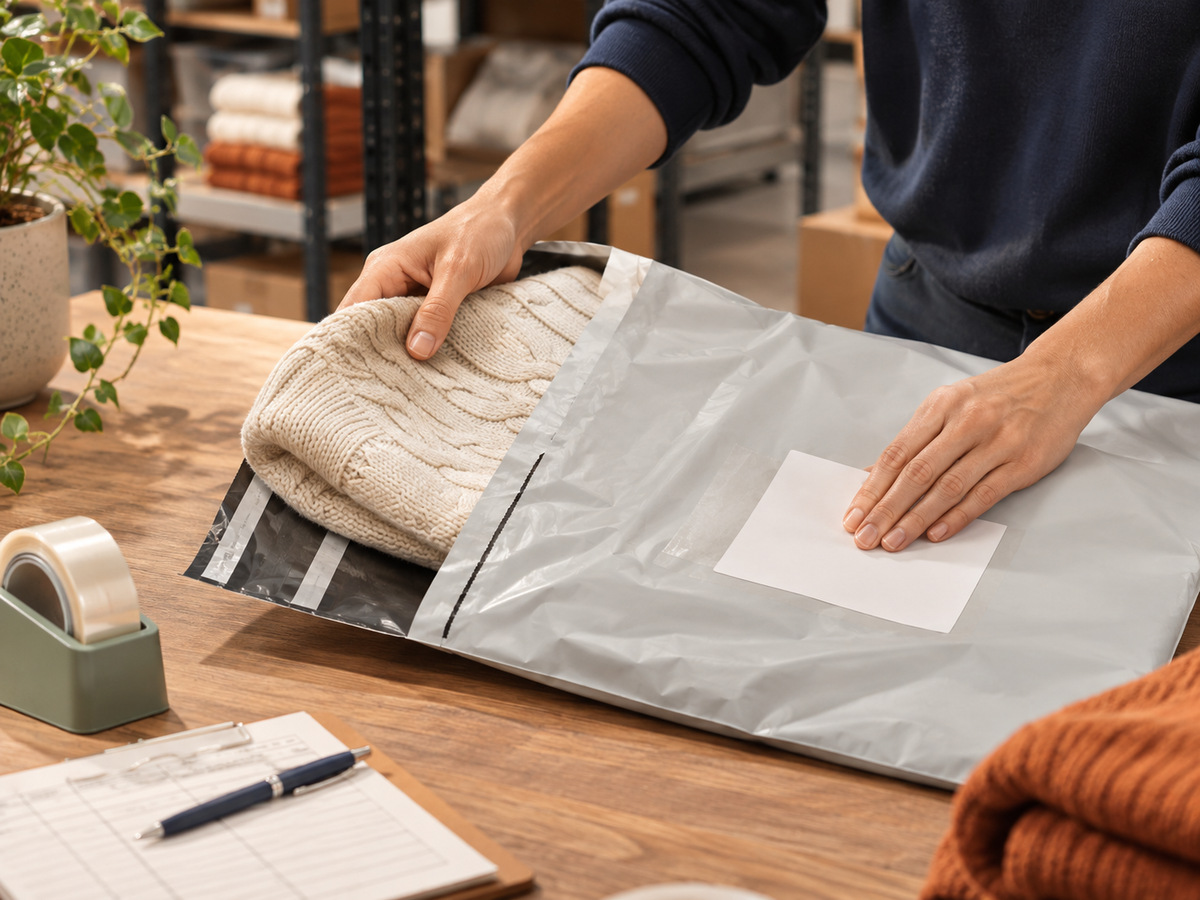
First, Confirm Your Return Channel Actually Uses the Bag
Before paying for dual-strip tooling and thicker film, check how your returns actually travel. If your brand routes most U.S. shoppers through box-free, label-free drop-off programs (such as FedEx no-box returns or consolidated drop-off kiosks), customers hand over the bare garment and never reseal the original bag.
Returnable poly mailers deliver real ROI when your reverse logistics rely on customer-packed mail-backs—where shoppers reseal the garment, apply a return label, and drop it with the carrier. If mail-back returns make up a meaningful share of your volume, upgrading the outbound bag eliminates the most common reason shoppers delay or abandon returns: hunting for a new box or tape.
Four Structural Specs That Make or Break a Two-Trip Mailer
1. Film Gauge: Build for Two Rounds of Conveyor Belts
A standard single-trip apparel mailer often runs around 2.0 to 2.5 mil in thickness. That is fine for one journey, but asking the same film to survive two rounds of automated sorting belts, chute drops, and weather exposure increases puncture and seam-split rates.
For two-trip apparel shipments, step up to 2.5 to 3.0+ mil co-extruded LDPE/HDPE film (or a thicker equivalent if you are running high-percentage recycled PCR content, which naturally has lower tear resistance). Heavier knitwear, denim, or multi-item orders should sit at the upper end of that range.
2. Opening Mechanism: Tear Strip vs. Perforation
Between the outbound seal and the return seal sits the opening path. If that path tears unevenly, it can rip straight into the return adhesive strip and ruin the bag.
|
Feature |
Integrated Tear Strip (Tear Tape) |
Perforated Tear Line |
|
Cut Cleanliness |
Straight, controlled tear with minimal effort |
Can veer off-line if pulled quickly or at an angle |
|
Flap Preservation |
Consistently leaves the return flap and second strip intact |
Higher risk of tearing into the return closure zone |
|
Unit Cost |
Slightly higher due to added tape application |
Lower; built directly into the film conversion |
|
Best For |
Mid-to-high-return apparel brands prioritizing unboxing UX |
Budget-sensitive programs with lighter, non-bulky garments |
For most apparel programs, a dedicated tear strip pays for itself by drastically reducing the number of bags shoppers accidentally destroy on opening.
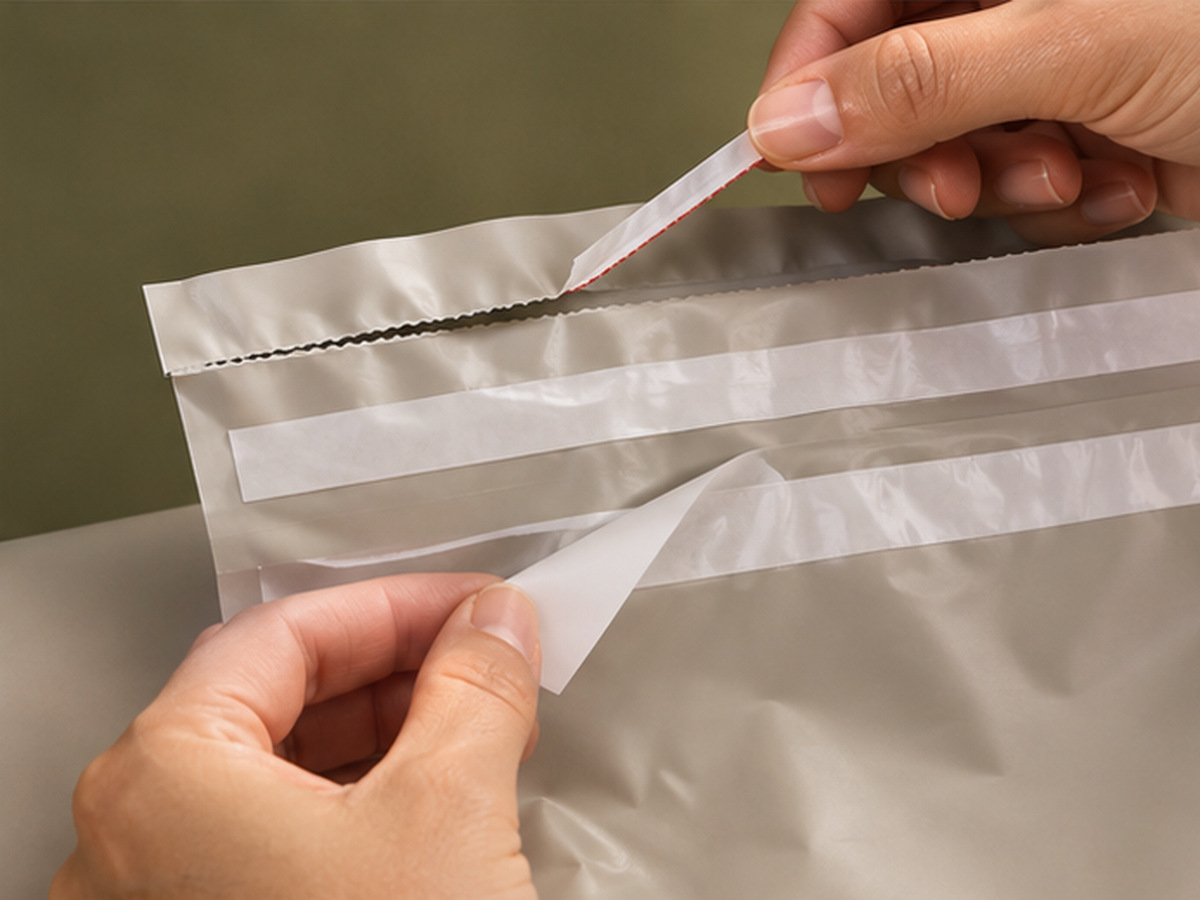
3. Dual Adhesive Strips & Release Liner Stability
Both strips should use a permanent destructive hot-melt adhesive—once sealed, the bag cannot be opened without visibly tearing the film, protecting both outbound and return shipments from tampering.
Pay close attention to the release liner covering the second (return) strip. That liner has to stay cleanly bonded through factory packing, warehouse storage, and outbound transit, yet peel off smoothly weeks later when the customer initiates a return. Poor-quality liners either curl up prematurely in warm storage or snap mid-peel, leaving the customer frustrated.
4. Size for the “Loose Refold” Reality
This is the single most overlooked factor in returnable apparel packaging: customers never fold clothes as tightly as your fulfillment team.
A cotton sweatshirt packed flat at your warehouse might fit comfortably in a 10” × 13” single-use mailer. After the shopper tries it on and loosely stuffs it back in, that same sweatshirt is 30% bulkier. Because the top of the bag has already been torn off along the opening path, the remaining flap often comes up short and cannot seat cleanly onto the return adhesive strip.
- Add length headroom: Build 5 to 2 inches of extra usable length into your returnable mailer compared to a standard single-trip bag for the same SKU.
- Consider a bottom gusset for bulky SKUs: For hoodies, fleece, and outerwear, a bottom gusset absorbs the extra loft of a messy refold without straining the side seams or shortening the flap reach.
Foolproof the Unboxing with Print and Label-Zone Design
Even a well-engineered bag fails if the customer grabs a pair of scissors and slices straight through the return adhesive strip. Good print design prevents user error before it happens:
- Make the opening path unmissable: Print bold, high-contrast cues directly along the tear strip (e.g., “TEAR HERE TO OPEN — SAVE BAG FOR RETURNS”).
- Label both adhesive strips clearly: Mark the outbound strip for your pack-bench staff (“Fulfillment Seal”) and the inner strip for the shopper (“Peel Here for Returns”) so packers never accidentally burn the return strip on leg one.
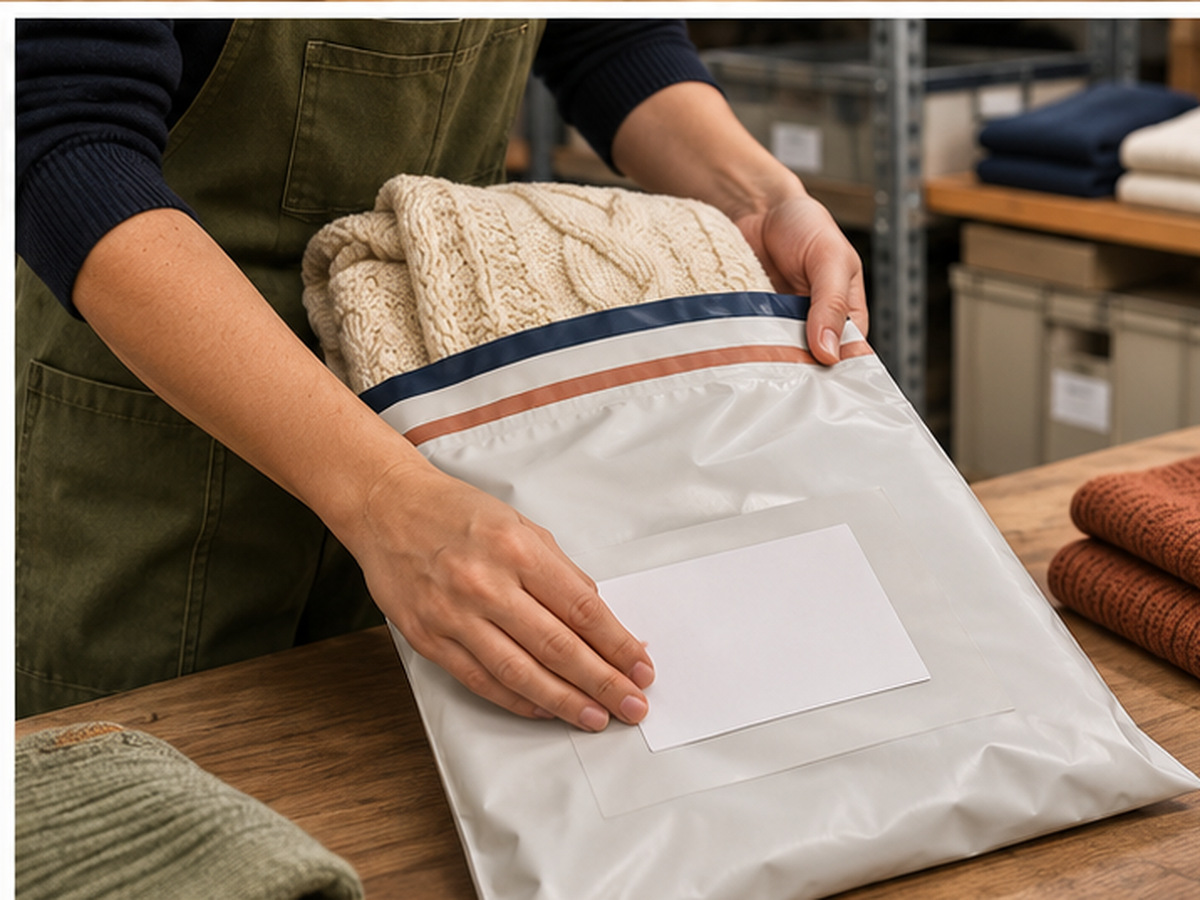
- Define a dedicated 4” × 6” label zone: Keep shipping labels well below the tear path so your fulfillment team does not tape over the tear strip. A clear label box also tells the customer exactly where to apply the return label—right over the old outbound barcode so carrier scanners do not misread the package.
Run a 10-Minute Blind Test Before Locking Your Die-Line
Catalog spec sheets cannot tell you how a bag behaves in a customer’s hands. Before signing off on bulk production, pull a finished sample with your actual film, adhesive, and tear path, and run a quick blind test:
- Pack it on your real bench: Have a warehouse associate pack your bulkiest target garment using only the first strip and apply a standard 4” × 6” shipping label. Check that they can spot the outbound strip instantly without slowing down pack speed.
- Hand it to an outsider: Give the sealed parcel to someone who has never seen the bag design. Give them no verbal instructions and watch how they open it. If they hesitate or reach for scissors, your print cues or tear tab need work.
- Force a messy refold: Have them pull the garment out, refold it casually, and slide it back in. Verify that the remaining flap easily reaches the second adhesive strip without pulling tight on the seams.
- Reseal and relabel: Peel the second liner, seal the flap, and stick a sample return label over the outbound label. Confirm the old barcode is fully covered and the bag feels solid enough for a second trip.
Spec Your Custom Returnable Mailer with Huayue
At Huayue Mailer Bags, we manufacture custom dual-strip poly mailers tailored for e-commerce apparel programs—including custom film gauges, PCR recycled blends, integrated tear strips, bottom gussets, and custom UX printing.
If you are evaluating returnable apparel mailers for your next production run, send us your target garment dimensions, estimated weight, and preferred opening style. Reach out via the Huayue contact form or email alfredren@huayuepack.com to request physical samples and dial in your closure spec.
Packing Solutions
Related Products

Tel: +86 18019228135
E-mail: alfredren@huayuepack.com
Address: No.228 ZhaiXing Rd, XinSheng Industrial zone, ZheLin Town, FengXian District, ShangHai, China.

Copyright © 2026 Huayue Group Plastic Packaging Manufacturers
