
 English
 Español
What Blown Film Extrusion Changes—and What Buyers Still Need to Specify
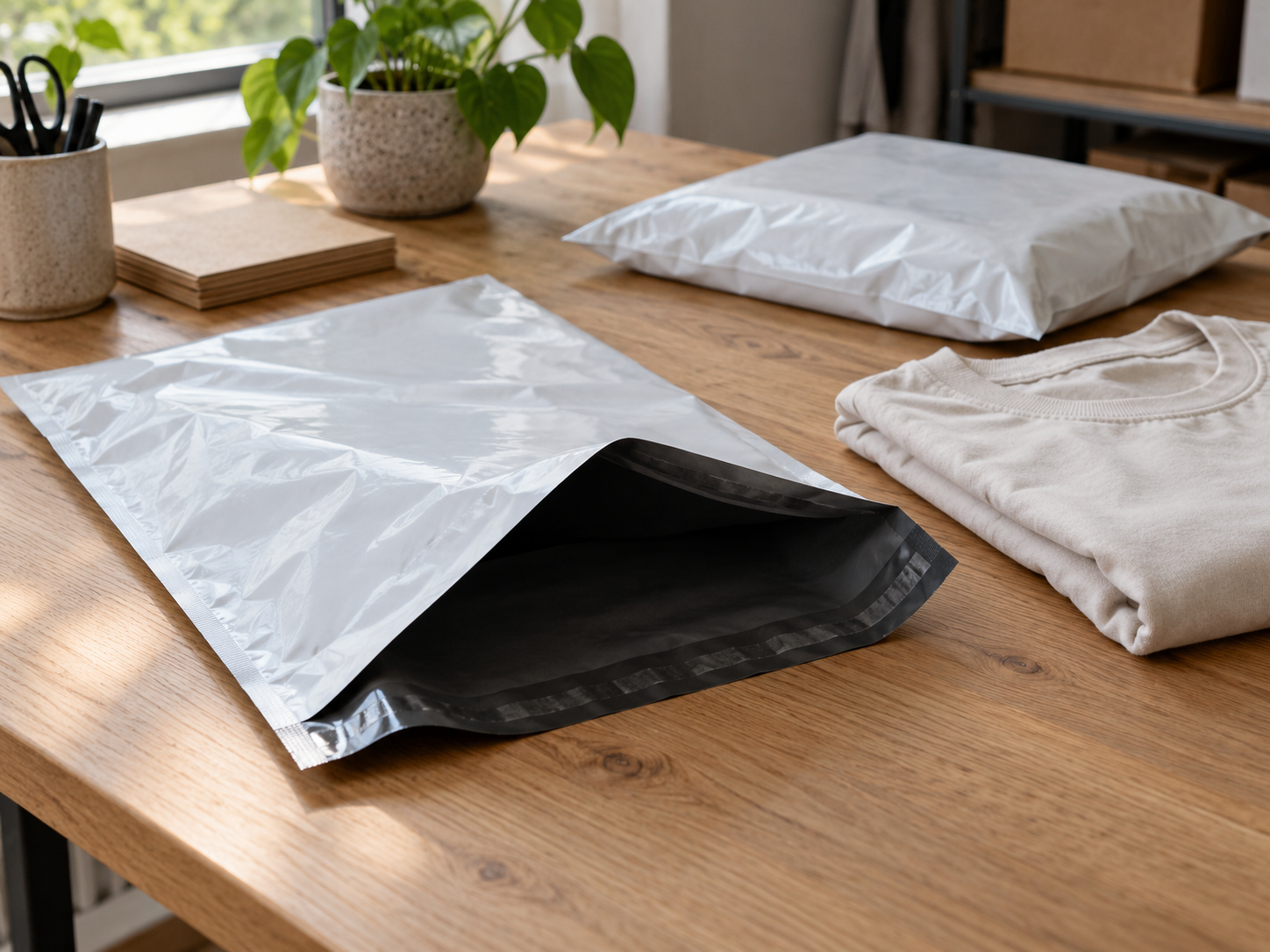
A typical request for custom poly mailers reads like this: “60 micron poly mailer, white, 30 × 40 cm. Please quote 50,000.” It looks complete. It isn’t. Is 60 micron one layer of film or both sides of the bag? Is 30 cm the width of the film tube or of the finished bag? Does “white” mean the shirt inside won’t show through?
Blown film extrusion decides a lot about the film those questions describe. But extrusion only produces the roll. Whether that roll becomes a bag that seals, closes, prints and survives your packing line is settled afterward, and a film sample can’t tell you. This article sorts out what the extrusion step sets, what you still have to write into the spec, and what you should see before you approve anything.
How the roll gets made
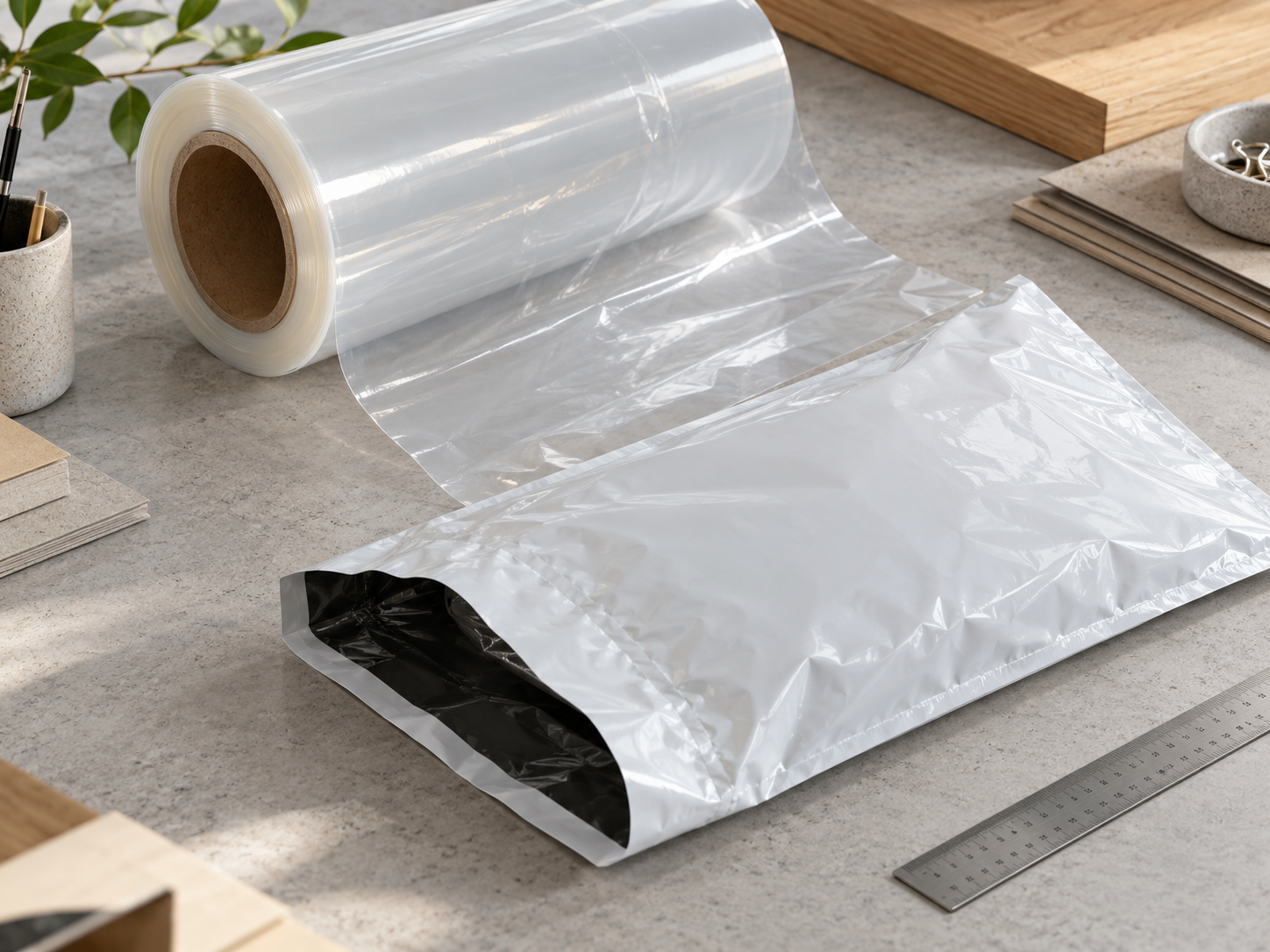
Resin pellets, plus any color or additive masterbatch, melt in an extruder and are pushed through a ring-shaped die as a tube. Air inflates the tube into a bubble, cooling air sets the film, and rollers flatten the bubble and wind it up.
The flattened tube has a width of its own, called layflat. That is a film dimension. It is not automatically the width of your finished bag, which depends on how the tube is later cut, sealed, trimmed or gusseted. Write the two down separately.
What the extrusion step sets
|
What extrusion sets |
Why it matters in a bag |
What to put in your spec |
|
Resin or blend (LDPE, LLDPE, HDPE, or mixes) |
Feel and toughness. LDPE is soft and seals easily. LLDPE adds puncture and tear resistance. HDPE is stiffer and crinkly. |
What the bag has to survive: sharp corners, heavy items, cold storage. Or write “supplier recommendation requested.” |
|
Layers (single layer or coextruded) |
In coextruded film, each layer can have a job: outer layer for print and appearance, core for strength, inner layer for sealing. |
The proposed structure, and what each layer is there for. |
|
Thickness and how even it is |
Thin spots are where tears start and seals weaken. |
Unit, single-wall basis, measuring method and tolerance (see next section). |
|
How the film is stretched as it forms |
Film can tear and stretch differently along the roll than across it. |
If the bag will be loaded hard, ask for tensile, tear or puncture results and agree the test method. |
|
Color, opacity, slip, surface treatment |
Whether the contents show through, how the bag handles on the line, and whether ink sticks. |
Color or opacity reference, print face, and whether the film is treated for printing. |
Equipment makers describe both single-layer and multilayer set-ups, as Davis-Standard’s blown film overview shows. That is a reason to ask which one you’re being quoted. It isn’t evidence that more layers are better.
Poly mailer thickness: four ways a number goes wrong
- The unit. Micron, mil and “gauge” get mixed up in quotes. One mil is 0.001 inch, about 25.4 microns. Write the unit every time.
- The wall. A mailer is two films folded or sealed together. “60 micron” can mean each side or both sides added up. Write “single-wall” if you mean one film.
- Nominal versus measured. A nominal thickness is a target. Ask how thickness is measured, where across the film, how many readings are taken, and how much spread you will accept.
- Thickness is not strength. Two films of the same thickness can behave differently depending on resin and structure. A thickness number alone doesn’t approve performance.
What extrusion can’t tell you
After the roll comes printing, cutting, sealing and closure. Some things only exist once that work is done: how strong the seals are, whether the adhesive strip still holds after sitting in a warehouse, whether the print rubs off, whether your product actually fits, and how the bag behaves on your packing line.
So ask for production-intent bags, made the way the real order will be made, and agree the checks before they arrive. Typical ones are a seal pull test, a drop test with real product, an adhesive strip peel test, a print rub test and a fit check. Standard film test methods exist for the film itself, such as ASTM D882 for tensile properties, D1709 for dart impact and D1922 for tear resistance. Agree which ones apply and what result counts as a pass for your program. No universal pass mark exists.
A worked example: the opaque apparel mailer
Imagine custom poly mailers for non-food apparel. The contents must not show through. Packing is done by hand and the bag ships by parcel. The buyer hasn’t decided on material or thickness.
- Write what you know. Finished drawing, closure type, print artwork, packing workflow. For material and thickness, write “supplier recommendation requested.” A borrowed number looks like a decision and isn’t one.
- Ask the converter to propose. A common route for opaque poly mailers is coextruded film with a pigmented outer layer and a dark inner layer, so light doesn’t pass through. Ask whether coextruded poly mailers are what’s being proposed and why. Mailers are often quoted somewhere around 50–90 microns (roughly 2–3.5 mil), which is exactly why the unit and the wall basis matter. Ask for the reasoning behind the proposed gauge instead of copying a figure.
- Check opacity on the film. Agree a reference sample first. Then put a dark item and a light item inside a sample bag, hold it against a bright light, and compare it with the reference. Both sides are now looking at the same thing.
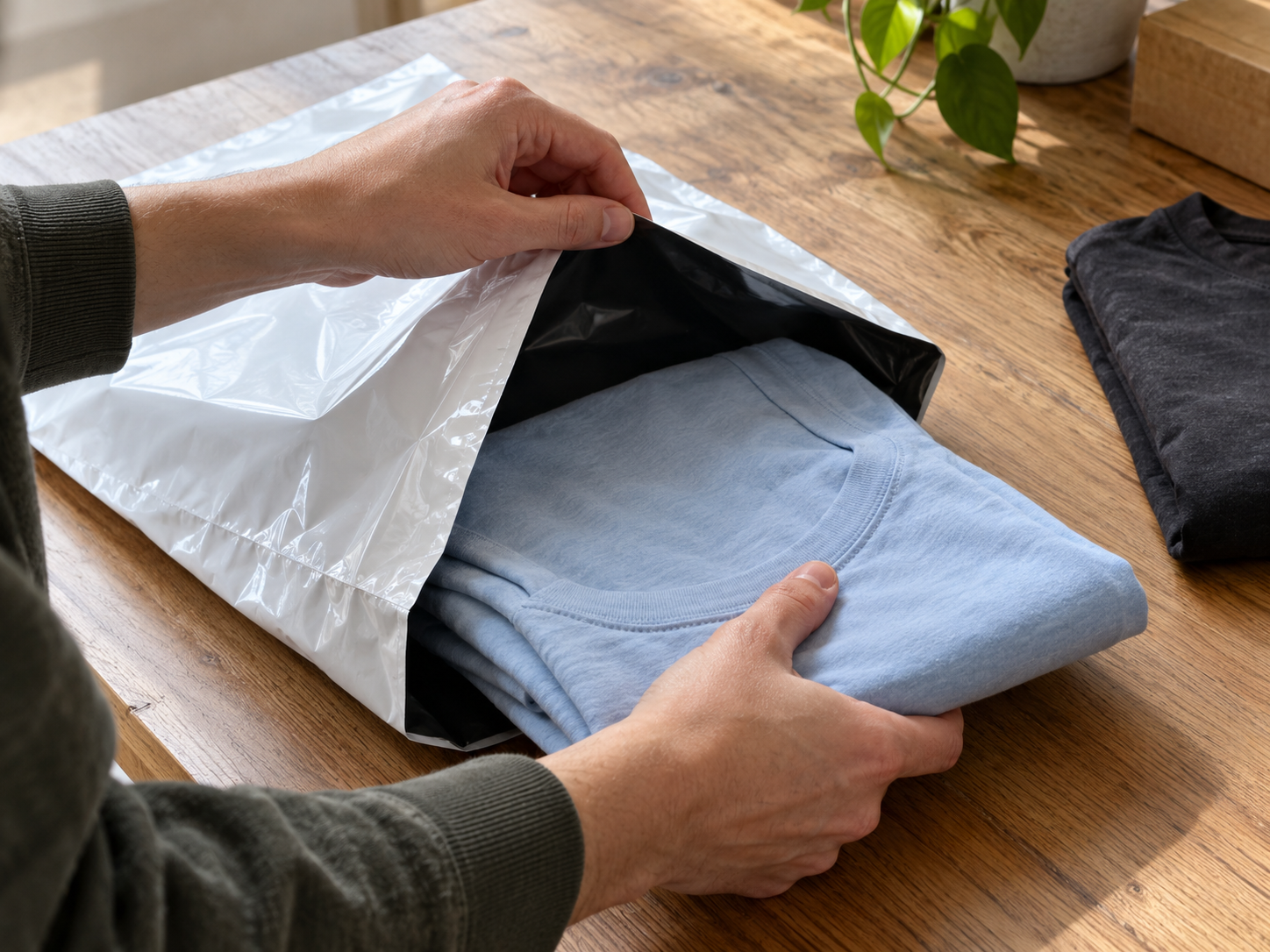
- Check everything else on production-intent bags. Seals, closure, print and fit are not settled by a film sample. Do these checks on finished bags.
- Reopen checks when something changes. If the structure or thickness changes later, redo the checks that depend on it: opacity, seals and drop test.
This example sets no thickness or layer count for your project. The right answer depends on your product, your packing line and your converter’s equipment.
What your approval should say
An approval is only as good as its record. Keep it specific:
Approved: spec revision B, sample batch 2, opacity and fit only. Still open: closure aging test. Signed: [name], [date].
When someone asks six months later what was agreed, that one line answers it. If the structure or gauge changes, the line tells you which approvals no longer apply.
Where Huayue fits
Huayue’s manufacturing page lists multilayer coextrusion blown-film equipment alongside bag-making equipment. For a buyer, that means film and bag conversion can be discussed in the same conversation. It doesn’t tell you which structure suits your mailer, and that is what the brief below is for. Mailer Bags sit in Huayue’s E-commerce Packaging category.
Send the brief
Planning a program for custom poly mailers? Send a short brief through the Huayue contact form or to alfredren@huayuepack.com. Include:
- What goes in the bag, how it is packed and shipped, and what the film has to do (hide contents, resist punctures, survive cold storage, and so on).
- A finished-bag drawing with dimensions, closure type, and which face is printed.
- Your current film, material and thickness, with unit and single-wall basis, or an explicit request for a recommendation.
- A reference sample if you have one, and the specific difference you want reviewed.
Packing Solutions
Related Products

Tel: +86 18019228135
E-mail: alfredren@huayuepack.com
Address: No.228 ZhaiXing Rd, XinSheng Industrial zone, ZheLin Town, FengXian District, ShangHai, China.

Copyright © 2026 Huayue Group Plastic Packaging Manufacturers
