
 English
 Español
Why Does Artwork Rub or Scuff Off Custom Printed Poly Mailers?
Custom printed poly mailers can match the approved proof exactly and still arrive with the print worn off at the corners. A proof only shows what the bag looks like. It doesn't show whether the ink is bonded to the film or whether it survives rubbing.
When print comes off, it's usually one of three problems:
- Ink adhesion:the ink never bonded well to the film.
- Scuff resistance:the ink bonded, but the surface can't take rubbing.
- Aging or set-off:the bags were fine when they left the factory and got worse in storage or transit.
For custom printed poly mailers, each has a different fix, so work out which one you have first.
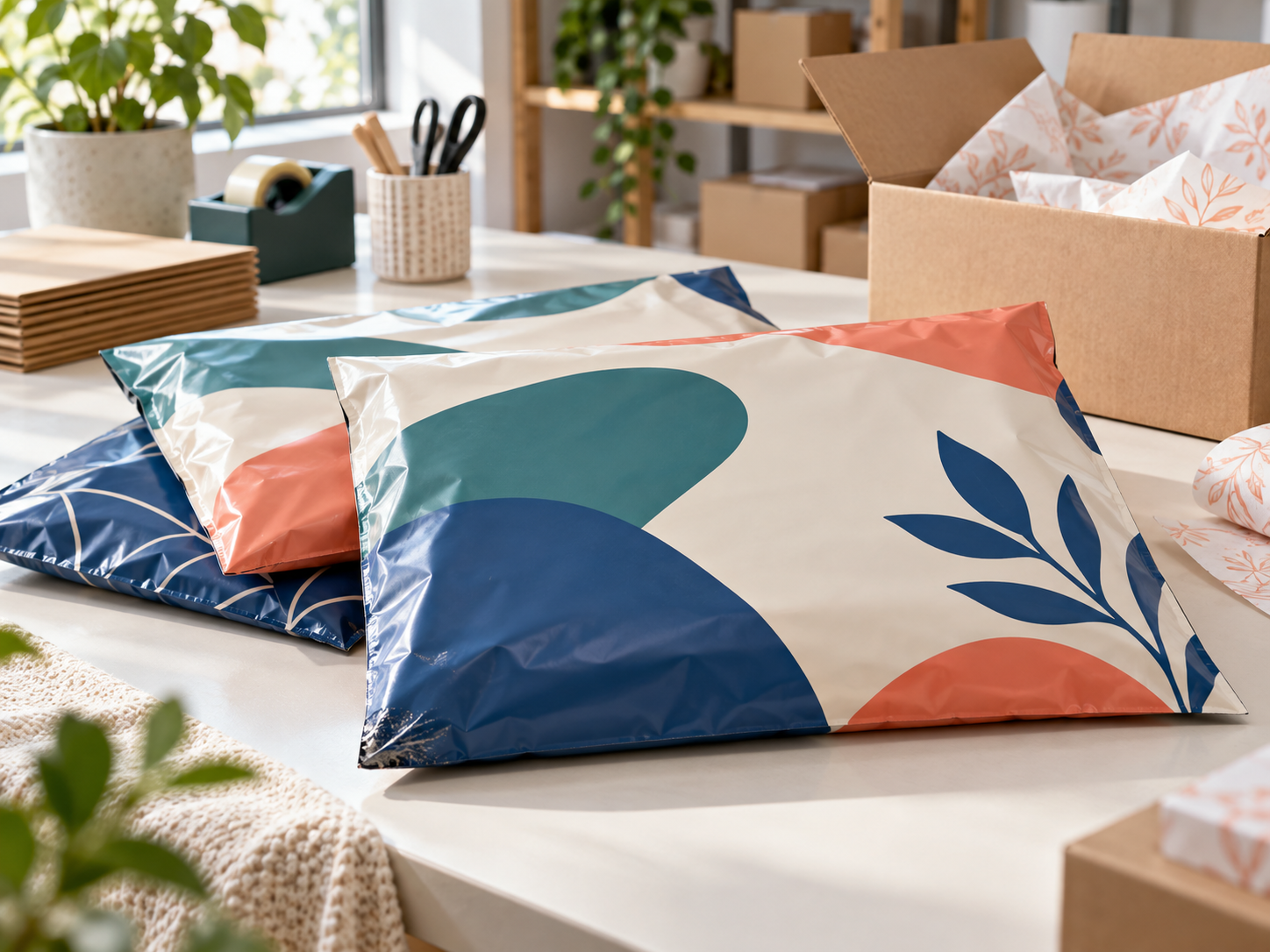
Match what you see to the likely cause
|
What you see |
Most likely cause |
Check first |
|
Ink lifts in patches when tape is pressed on and pulled off |
Weak adhesion: low film surface treatment, slip additive on the surface, or the wrong ink |
Tape test on a fresh, unhandled bag |
|
Print wears off where bags rub each other, a carton, or a conveyor |
Unprotected ink surface, or ink not fully cured |
Rub test print-to-print; ask if a varnish was used |
|
Fresh bags look fine, but worse after weeks in storage or transit |
Surface treatment faded, or slip additive migrated to the surface |
Test bags from the same lot at day 0 and after storage |
|
Color shows up on the neighboring bag or the packing material |
Ink not dry enough when rolled, plus heat and stack pressure in the carton |
Ask about drying and roll storage; check carton temperature |
|
Cracking or flaking along folds and seals |
Heavy solid ink flexing at the fold |
Check where the artwork sits across fold lines |
The usual causes, in plain terms
Low surface treatment in PE bag printing. PE is naturally slick and doesn't hold ink well. Film is corona-treated before printing to raise its surface energy, measured in dyn/cm, and the treatment fades over time. A roll that sat in a warehouse for months can print worse than a fresh one. Ask your converter what dyn level the film was at when it was printed and how old the roll was. Answers like "it's treated" don't tell you anything. Typical targets run around 38–42 dyn/cm depending on the ink.
Slip additive. Many PE films contain slip agent so the film runs smoothly and the bag opens easily. Over time it migrates to the surface, and a slippery surface holds ink poorly. If print keeps failing, ask whether the printed layer can use a low-slip formulation.
Ink system and coverage. Solvent-based and water-based inks behave differently on PE. Large solid areas, especially dark, heavy, or metallic ones, are harder to keep on than text and thin lines. If the scuffing sits in one big solid block, reducing coverage or changing the ink is often the quickest fix.
Drying and packing. Ink that isn't fully dry when the film is rewound can stick to the next layer. Hot warehouses and tightly packed cartons make it worse. Full drying before rewind, lighter coverage, and less stacking pressure in hot conditions all help.
No protective layer. Most mailers are printed on the outer surface, so nothing covers the ink. An overprint varnish (OPV) adds a protective coat and can reduce scuffing, but it has to be compatible with your ink and film. Ask the printer to test it on your actual material. Laminated structures protect the print better, but they cost more and are less common for mailers.
Artwork at folds. Heavy solids across a fold line flex every time the bag is folded, packed, or handled. Keep key artwork away from folds, or reduce ink coverage there.
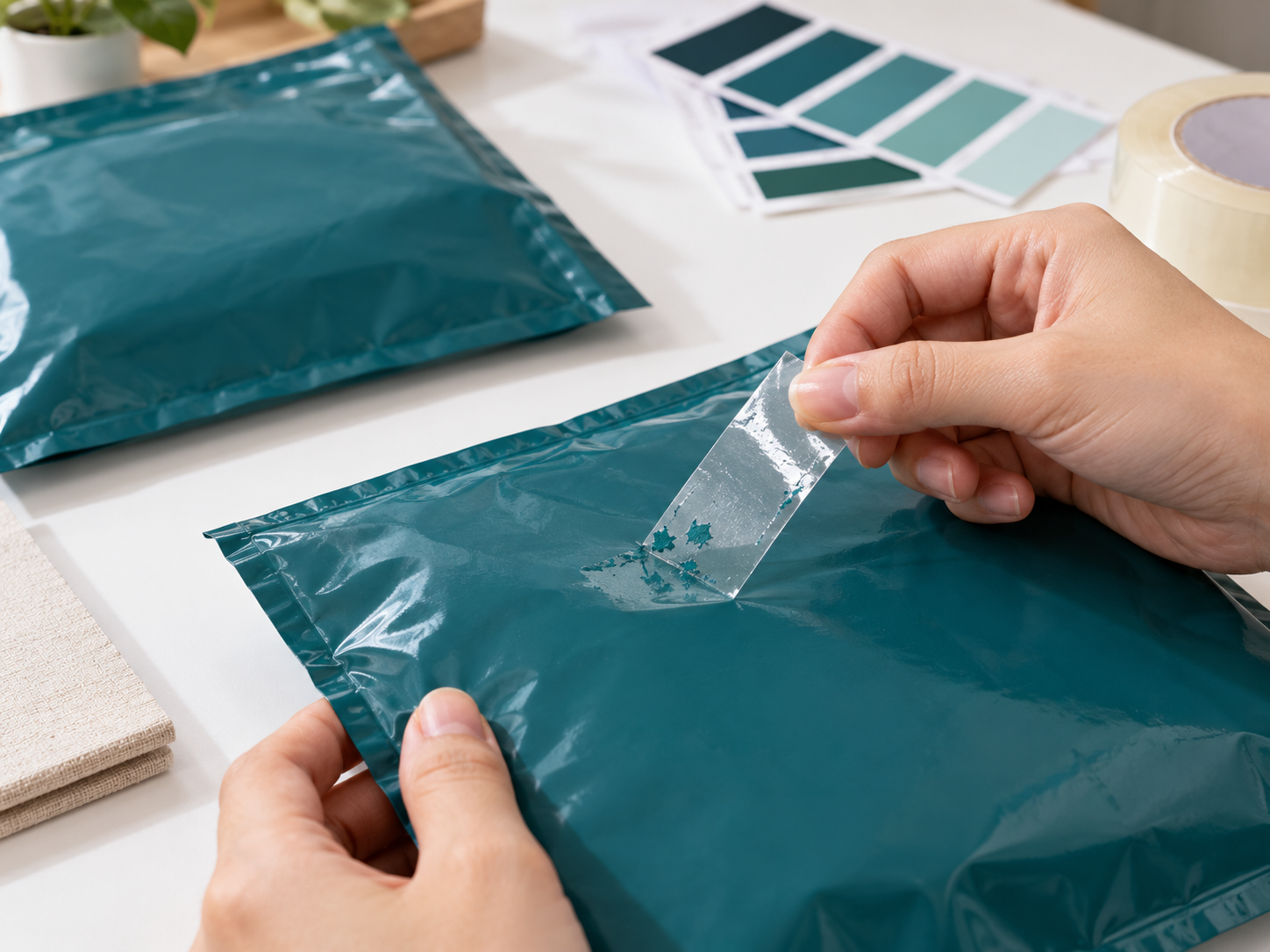
A ten-minute check you can do on samples
Test a fresh bag, a bag from the same lot after storage or transit, and an unhandled reference if you have one.
- Tape test. Press a strip of pressure-sensitive tape onto a solid printed area and rub it down firmly with your thumb. Pull it off at a steady, quick pace. If ink comes away on the tape or the film shows through, you have an adhesion problem. Photograph both the tape and the bag.
- Rub test. Rub two bags together, print to print, using the same pressure and the same number of strokes on every sample (20, for example). Repeat with print against a piece of the carton. Compare each result with the reference.
- Compare the same spot on every sample. Fresh versus aged versus transit tells you whether the problem starts in production or develops afterward.
Write it into your PE bag printing sample approval
Add these to the approval sheet or purchase order so the question doesn't come back on the repeat run:
- Printed face, ink type (solvent-based or water-based), and whether OPV is used
- Film surface treatment level at printing (dyn/cm) and slip level
- Artwork revision, lot number, and production date
- Tape and rub test results on the approved sample, with photos and the agreed acceptable result (for example, "no ink on the tape in solid areas")
- A signed retained sample for both sides
- Approver name and date
Example: scuffing after carton packing
Two custom printed poly mailers, same artwork revision. One is scuffed after cartoning, and the retained sample is clean.
- Run the tape test on both. If ink lifts from the clean retained sample too, ink adhesion was weak from the start. Look at surface treatment, slip, and ink with the printer.
- If the tape test passes, run the rub test print-to-print and print-to-carton. If the print scuffs easily, the ink surface needs protection or less coverage. Add OPV or lighten the solids in the contact areas.
- Look at where the scuffs are. If they sit at the corners that touch the carton edge, packing is the main issue. Try fewer bags per carton or less stacking pressure. If they're spread across every contact surface, it's the ink surface.
Send us your samples
If your custom PE bags are already showing this, send the following to alfredren@huayuepack.com or through the Huayue contact page:
- Photos and a short description of the failed and good samples
- Bag format, film, and printed face
- Artwork revision, lot number, and date
- Where and when the print changed
We run flexographic and gravure printing. Send us the evidence and we'll tell you which of the causes above looks most likely and what to change on the next run.
Packing Solutions
Related Products

Tel: +86 18019228135
E-mail: alfredren@huayuepack.com
Address: No.228 ZhaiXing Rd, XinSheng Industrial zone, ZheLin Town, FengXian District, ShangHai, China.

Copyright © 2026 Huayue Group Plastic Packaging Manufacturers
