
 English
 Español
The Ultimate Guide to Kraft Paper Sack Bags & SOS Bags
1. What Are Kraft Paper Sack Bags & SOS Bags?
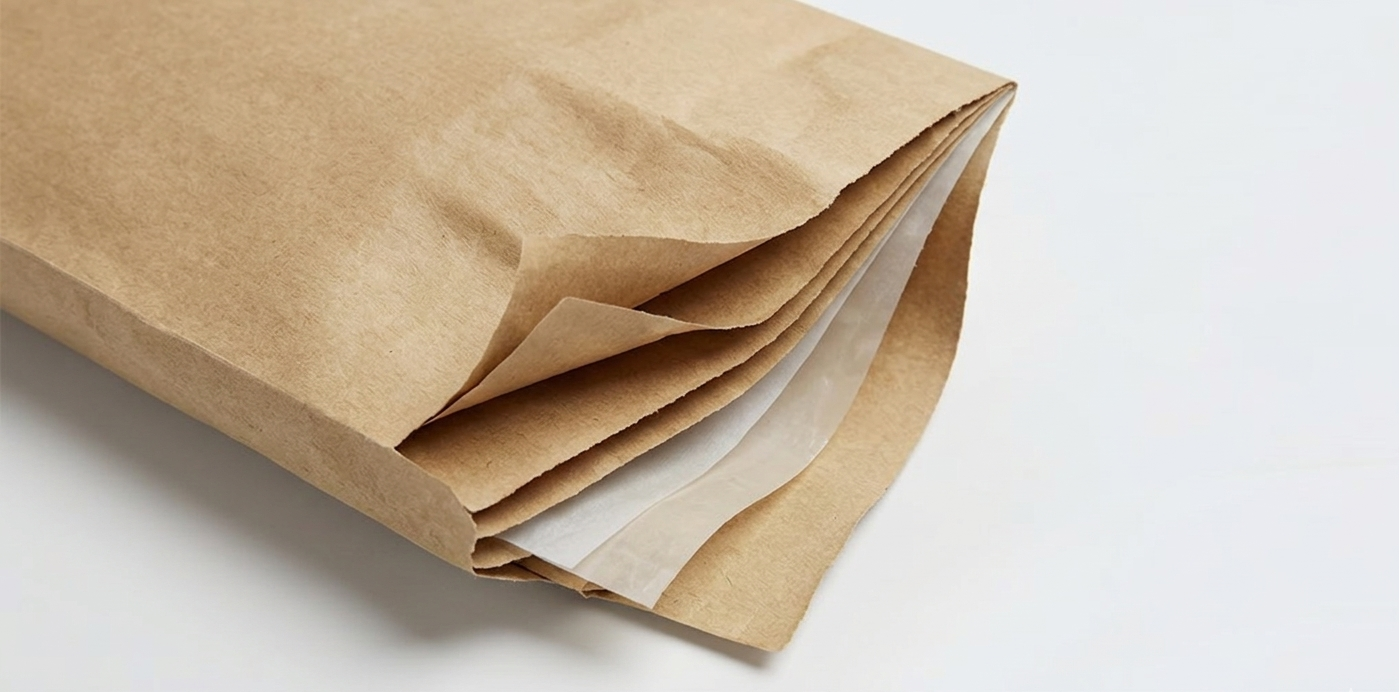
Kraft paper sack bags are heavy-duty, multi-ply paper bags designed to carry bulk industrial materials such as cement, flour, animal feed, and chemicals. Made from virgin or recycled kraft pulp, they offer high tensile strength combined with controlled breathability.
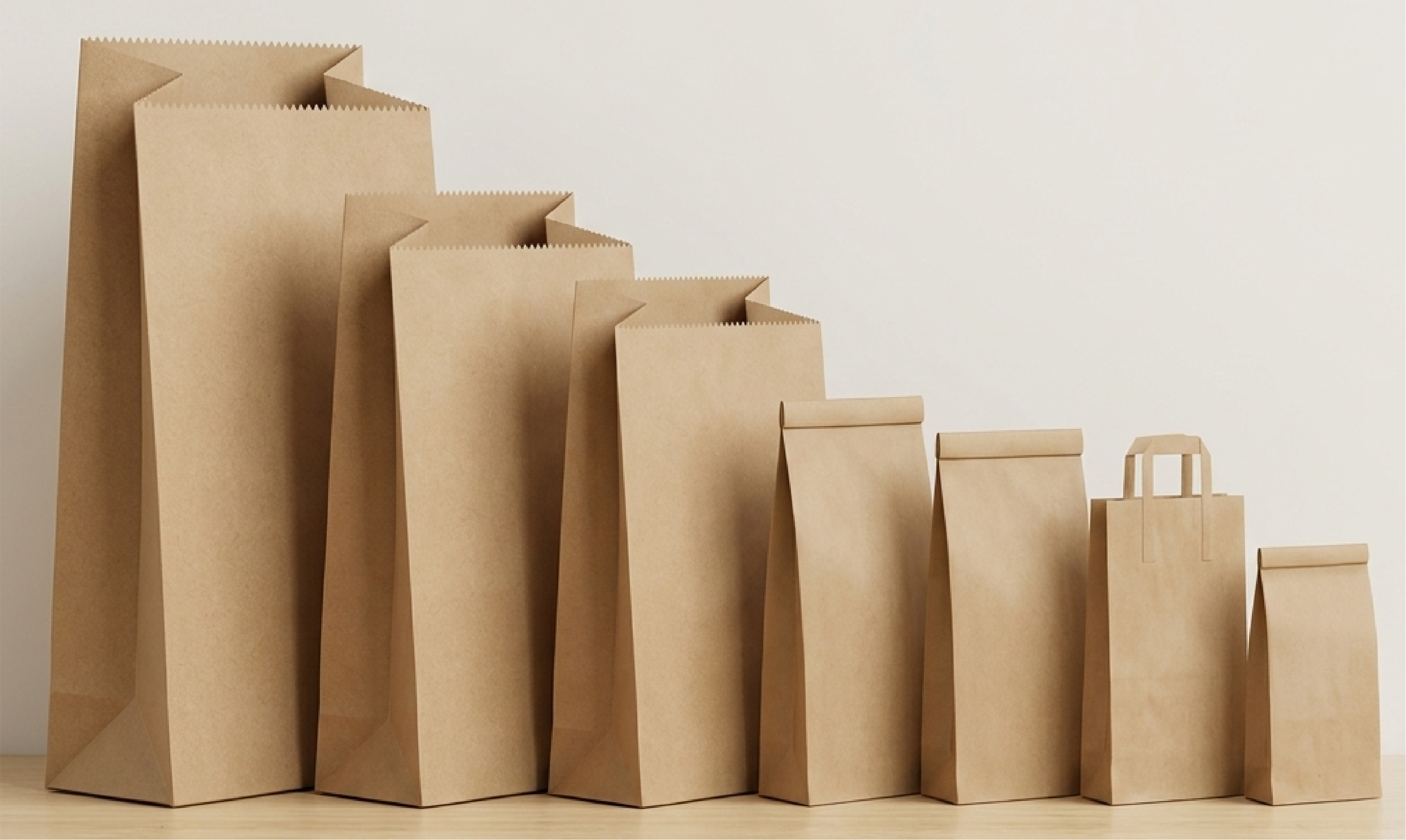
SOS bags (Self-Opening Satchel) — also called grocery bags or carry-out bags — are flat-bottomed, gusseted paper bags with a square base that allows them to stand upright on their own. Originally patented in the 1870s, they remain one of the most widely produced bag formats in the world.
Huayue Group has manufactured both industrial kraft sacks and SOS bags since 1998, with four major production bases in Shanghai, Zhejiang, Henan (China), and Sihanouk (Cambodia), ensuring reliable supply for global clients across all bag formats and ply configurations.
2. Material & Ply Options
Virgin kraft vs recycled kraft
Unbleached virgin kraft retains maximum tear resistance and is standard for industrial sacks. Recycled-content kraft is increasingly preferred for retail SOS bags — it meets sustainability targets without sacrificing typical load requirements under 5 kg.
Ply count guide
|
Ply count |
Typical GSM |
Best for |
|
1-ply |
70–90 gsm |
Light retail, SOS grocery bags |
|
2-ply |
140–180 gsm |
Deli, bakery, hardware items |
|
3-ply |
200–270 gsm |
Animal feed, fertilizer, flour |
|
4–6-ply |
300–450+ gsm |
Cement, chemicals, heavy industrial |
Liners and coatings
Moisture-sensitive products benefit from inner PE liners or bitumen layers. Note that PE-laminated bags are harder to recycle. For food applications, PE-free grease-resistant coatings offer a more sustainable alternative and are increasingly available from specialty mills.
At Huayue Group, we offer the full ply range from single-ply SOS bags to 6-ply industrial sacks. Our product lines include PE-lined and PE-free options, as well as grease-resistant food-grade coatings — all available with FSC-certified fiber sourcing to support your sustainability goals.
3. Top Applications by Industry
Kraft paper bags serve a wide range of sectors -
- Agriculture & animal feed — multi-ply sacks for grain, flour, and pet food
- Construction materials — valve-fill sacks for cement, gypsum, and lime
- Chemicals & minerals — closed-mouth sacks with inner liners for powders
- Bakery & deli — food-grade SOS bags for direct food contact
- Retail carry-out — branded SOS bags in standard or custom sizes
- Fast food & takeaway — double-ply SOS bags for hot food containers
- Coffee & specialty food — SOS bags with grease-resistant treatment
- Pharmaceutical ingredients — multi-ply sacks with regulatory compliance
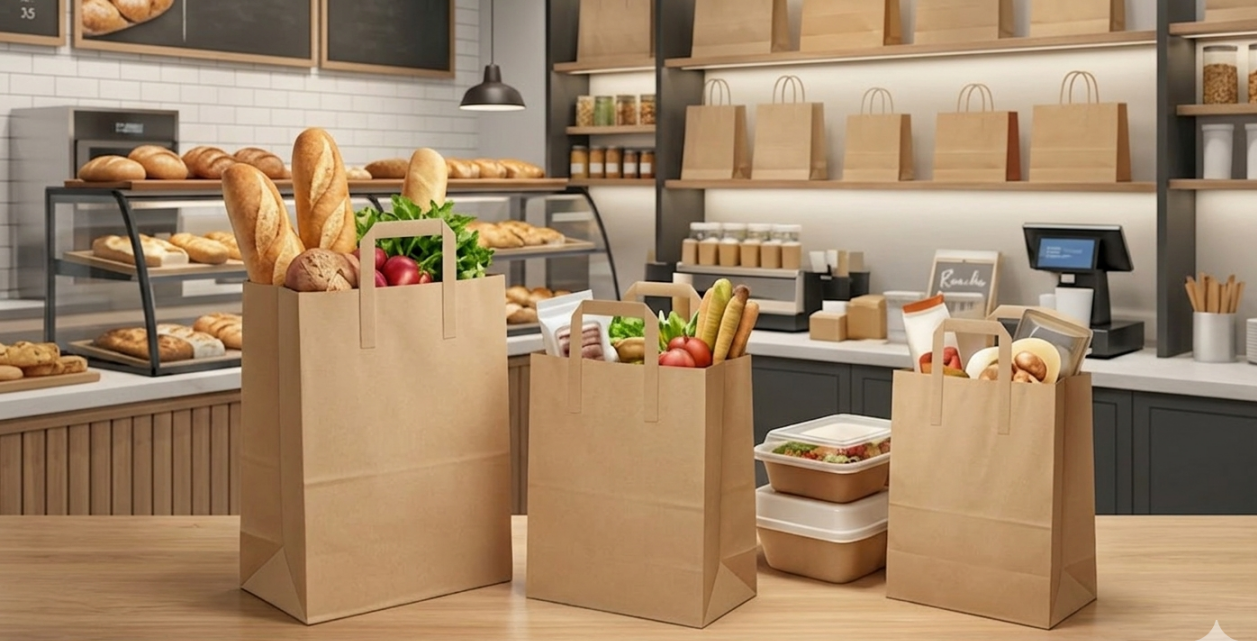
In foodservice, #12–#20 SOS bags are the most common for takeout orders. Double-ply versions handle wet food containers without structural failure. FDA-compliant food-grade inks and adhesives are required in this segment.
In industrial applications, valve-mouth sacks (machine-filled and self-sealing) dominate cement and chemical production, while pinch-bottom sewn sacks remain standard for flour milling and animal nutrition.
Huayue Group serves clients across e-commerce, retail, medical packaging, and food & household product sectors. Our dedicated R&D teams develop differentiated, application-specific packaging solutions for each vertical — from FDA-compliant food-grade SOS bags to heavy-duty industrial sacks rated for 50 kg loads.
4. Standard Sizes Reference
SOS bag sizes
|
Size # |
Dimensions W×G×H (inches) |
Common use |
|
#2 |
4.31 × 2.38 × 7.88 |
Small deli, candy |
|
#4 |
5.00 × 3.13 × 9.75 |
Sandwiches, snacks |
|
#6 |
6.00 × 3.63 × 11.06 |
Bottles, small gifts |
|
#8 |
6.13 × 4.00 × 12.44 |
Standard grocery items |
|
#12 |
7.06 × 4.50 × 13.75 |
Bakery, takeout orders |
|
#20 |
8.25 × 5.25 × 16.13 |
Full grocery, food delivery |
|
#25 |
8.69 × 5.50 × 16.75 |
Large grocery, bulk retail |
Industrial kraft sacks are specified by fill weight (e.g. 25 kg, 50 kg) rather than bag number. Always confirm inner dimensions after gusseting and provide product bulk density when requesting samples.
Huayue Group stocks all standard SOS sizes (#2–#25) and manufactures industrial sacks in 25 kg and 50 kg rated configurations. Custom dimensions are available from our production bases, with competitive lead times driven by our ~1 billion RMB annual production scale.
5. Sustainability & Certifications
Paper bags score well on biodegradability and compostability, but their production is resource-intensive. The sustainability case is strongest when bags are reused, collected, and recycled through established paper recycling streams.
|
Certification |
What it covers |
Relevant for |
|
FSC / PEFC |
Responsible forestry sourcing |
All kraft products |
|
FDA 21 CFR |
Food contact safety (US) |
Food-grade SOS bags |
|
EU 10/2011 |
Food contact materials (EU) |
Export to Europe |
|
OK Compost |
Industrial compostability |
Unlined bags only |
|
ISO 9001 |
Quality management system |
Industrial sack suppliers |
Bags with PE inner liners cannot be certified compostable. If marketing bags as sustainable, avoid poly coatings and use barrier papers or kraft-plus-wax alternatives where the application permits.
As a sustainability-focused group, Huayue holds FSC certification across our kraft product lines and actively supports PE-free coating transitions. Our Cambodia and China facilities maintain ISO 9001 quality management systems. As global regulations tighten, we help clients stay ahead with compliant, certified packaging sourced from responsible forestry.
6. Printing & Branding Options
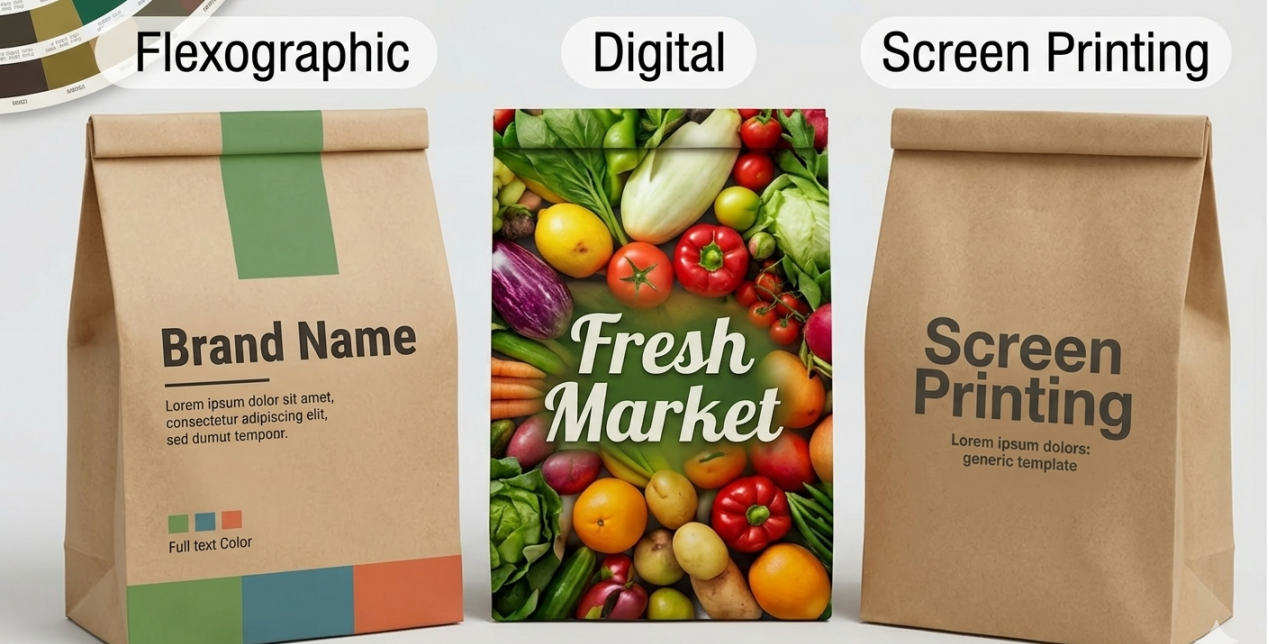
Flexographic printing
The industry standard for kraft bags. Cost-effective for long runs of 10,000+ units, handles spot colors well, and suits the uneven kraft surface. Typical registration tolerance is ±1.5 mm — suitable for logos and text, but not photographic detail.
Digital printing
Growing in adoption for short runs and seasonal designs. No plate costs, faster turnaround, and capable of photorealistic output. Per-unit cost is higher but increasingly competitive below 5,000 units.
Screen printing
Best for high-opacity spot colors, particularly white ink on natural kraft. Favored by boutique retailers seeking bold, graphic brand identities.
Always request a proof on the actual paper stock. Natural kraft color shifts ink appearance significantly compared to digital mockups, and white ink opacity on kraft varies between suppliers.
Huayue Group's in-house printing capabilities cover flexographic, digital, and screen printing across all bag formats. Our New York and Hong Kong marketing service centers provide local brand consultation, while production handles everything from PMS color matching to food-safe ink formulations — supporting both short promotional runs and high-volume retail programs.
7. Buying Guide - What to Confirm Before You Order
For SOS bags
- Bag size number and actual inner dimensions
- GSM / ply count and paper grade
- Food-contact compliance if used for food
- Print colors (PMS reference), printing method, and lead time
- Minimum order quantity — typically 500–5,000 for stock; 10,000+ for custom print
- Pack quantity per case and pallet configuration
For industrial kraft sacks
- Fill weight and product bulk density
- Closure type - valve, pinch-bottom, or sewn
- Number of plies and inner liner requirements
- Moisture barrier specifications
- Fill method - high-speed machine vs manual
- Palletizing and stretch-wrap requirements
- Required certifications and regulatory compliance documents
MOQ for custom industrial sacks typically ranges from 5,000 to 50,000 units. Request a structural certification or drop-test report for sacks rated at 25 kg or more.
8. Conclusion
Choosing the right paper packaging is a balance between structural integrity, functional requirements, and brand identity. While heavy-duty kraft sack bags remain the backbone of industrial bulk logistics due to their multi-ply durability and high load capacity, SOS bags offer an adaptable, self-standing solution that enhances the consumer experience in retail and foodservice. As global regulations shift toward more sustainable materials, the transition to PE-free coatings and FSC-certified fibers has become more than a trend—it is a market necessity. By carefully evaluating your product’s density, filling method, and sustainability goals, you can select a packaging solution that not only protects your contents but also aligns with modern environmental standards and operational efficiency.
Packing Solutions
Related Products

Tel: +86 18019228135
E-mail: alfredren@huayuepack.com
Address: No.228 ZhaiXing Rd, XinSheng Industrial zone, ZheLin Town, FengXian District, ShangHai, China.

Copyright © 2026 Huayue Group Plastic Packaging Manufacturers
