
 English
 Español
The Ultimate Guide to Non-Sterile Blue Sponge Counter Bags

Regulatory Classification and Product Scope
Non-sterile blue sponge counter bags are classified as non-sterile, single-use medical accessories under FDA 21 CFR Part 880 (General Hospital and Personal Use Devices). Because the bag functions exclusively outside the sterile field — receiving used sponges that have already exited the operative site — it does not require sterile packaging or sterility validation per ISO 11135 or ISO 11137. This classification distinction has direct implications for procurement - buyers should confirm that suppliers hold the appropriate 510(k) clearance or are operating under a valid FDA establishment registration, and that the product's intended use is correctly scoped in the device's labeling.
Huayue Group — How We Comply
Huayue Group's sponge counter bags are classified and labeled strictly as non-sterile, single-use medical accessories in accordance with FDA 21 CFR Part 880.
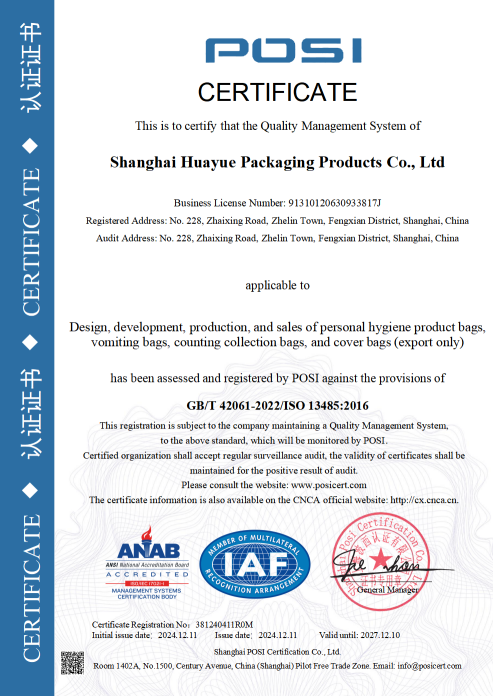
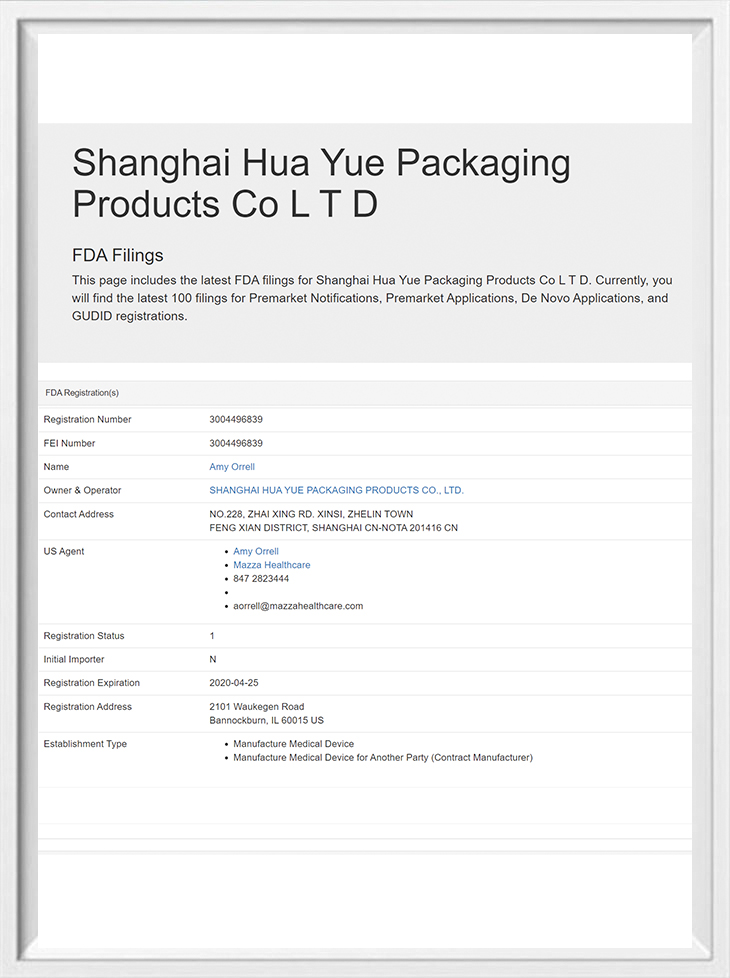
- U.S. Market - Huayue holds a valid FDA Establishment Registration and operates under the applicable 510(k) framework, with product labeling correctly scoped to the intended use.
- EU Market - Products carry CE marking under EU MDR 2017/745 as Class I medical devices. A current Declaration of Conformity and complete Technical Documentation are maintained and available to buyers on request.
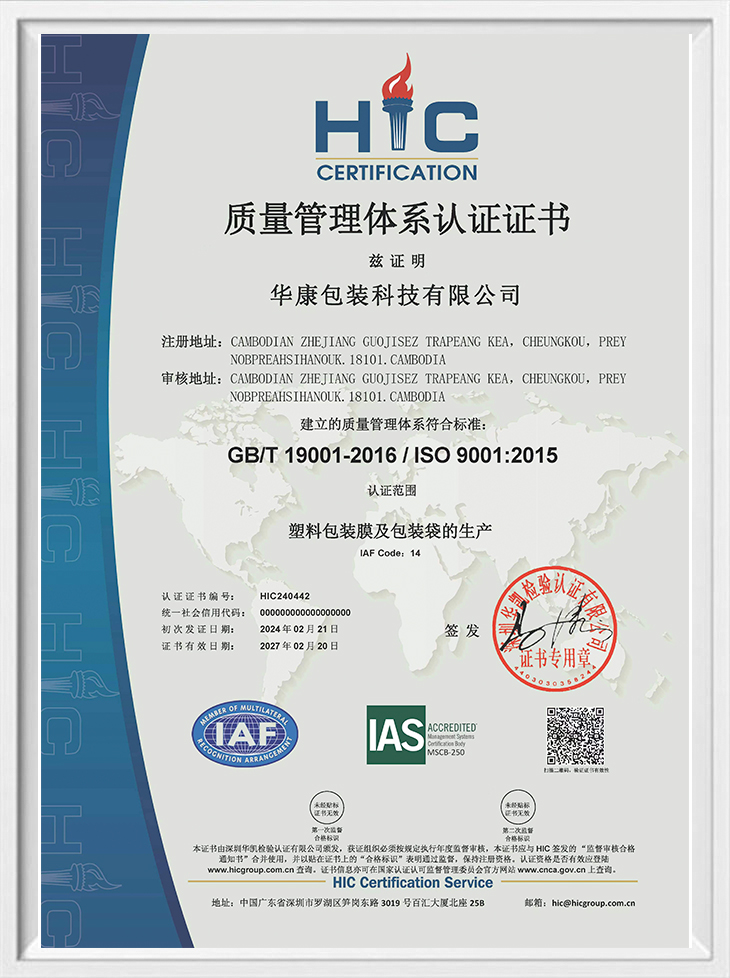
- Quality System - Huayue Group is certified to ISO 13485:2016 and ISO 9001, ensuring the QMS meets all requirements for medical device accessory manufacture. Products are also BRC-certified to international consumer product safety standards, and the company maintains active FDA Establishment Registration — together demonstrating our commitment to quality at every level.
Manufacturing Environment Requirements
Production should occur in a minimum ISO Class 8 cleanroom (ISO Class 7 preferred for high-volume hospital contracts). Key controls include continuous particle monitoring (0.5 µm), HEPA-filtered positive-pressure air, gowning protocols, temperature/humidity controls (18–22°C, 30–60% RH), and regular bioburden monitoring. Buyers should request IQ/OQ/PQ documentation and ongoing environmental monitoring logs.
Huayue Group — How We Comply
Huayue Group operates dedicated cleanroom production facilities across its four manufacturing bases in Shanghai, Zhejiang, Henan (China), and Sihanouk (Cambodia).
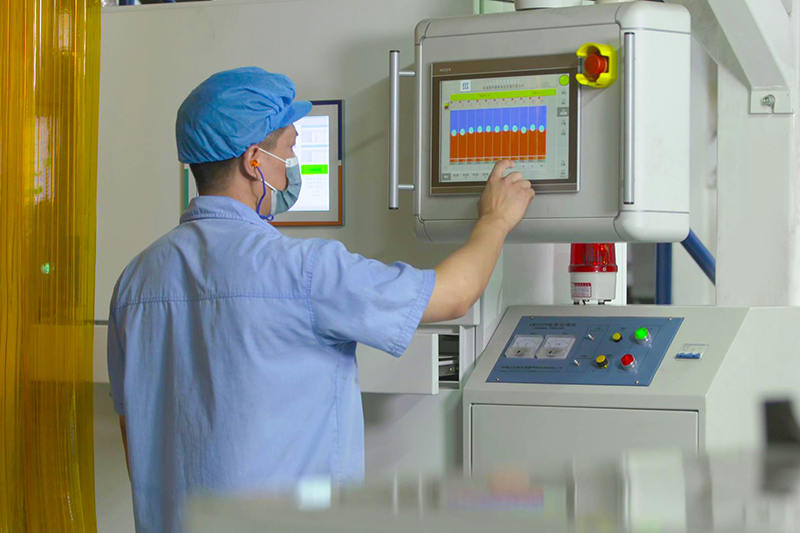
- Cleanroom Classification - ISO Class 7 / Class 8 certified cleanrooms for medical packaging production.
- Particle Monitoring - Continuous particle monitoring (≥0.5 µm) with documented threshold alert records.
- Air Supply - HEPA-filtered positive-pressure air supply systems across all medical packaging lines.
- Personnel Controls - Full gowning protocols, access control systems, and regular personnel training logs maintained.
- Environmental Monitoring - Regular bioburden and microbial contamination monitoring with documented logs.
- Qualification Records - IQ/OQ/PQ documentation for all cleanroom facilities is available upon request for supplier audits.
Material Compliance and Chemical Safety
Transparent film is typically medical-grade PE or PP. Compliant materials must meet ISO 10993 (biocompatibility), RoHS Directive 2011/65/EU, and REACH Regulation (EC) No 1907/2006 (no SVHCs above 0.1% w/w). The blue colorant must be non-migratory, non-toxic, and validated per ISO 10993-12.
Huayue Group — How We Comply
Huayue Group uses exclusively medical-grade polyethylene (PE) and polypropylene (PP) films across its sponge counter bag product lines, sourced from validated, certified raw material suppliers.
- ISO 10993 Compliance - Full biocompatibility evaluation reports covering ISO 10993-1, -5, and -10 are maintained for all materials and available upon request — not merely certificates of conformance.
- RoHS Compliant - All products meet RoHS Directive 2011/65/EU requirements; documentation available for EU buyers and GPOs.
- REACH Compliant - Confirmed that no SVHCs are present above 0.1% w/w in any article supplied.
- Blue Colorant Safety - The blue pigment used is non-migratory and non-toxic, validated per ISO 10993-12. Pigment safety data sheets are available on request.
Quality Control - AQL Standards and Inspection Protocols
Medical device procurement requires documented Acceptance Quality Limit (AQL) inspection protocols aligned with ISO 2859-1 (ANSI/ASQ Z1.4). For sponge counter bags, buyers should expect -
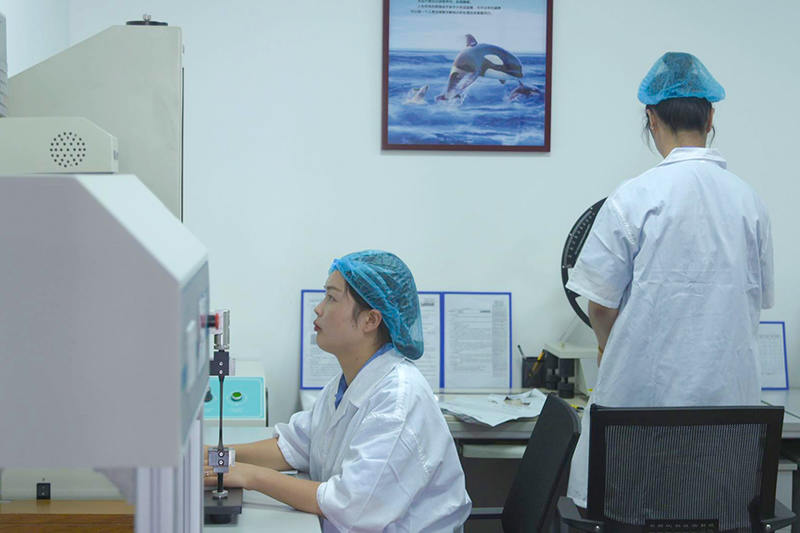

- AQL 1.0 or tighter for critical functional defects — pocket seal integrity, transparency, and fluid containment (any leakage is a critical defect)
- AQL 2.5 for major defects — dimensional non-conformance, improper pocket count, incomplete sealing
- AQL 4.0 for minor defects — cosmetic surface marks, label placement variance
Lot traceability is mandatory, with full traceability to raw material certificates, production date, cleanroom batch records, and QC sign-off, supporting compliance with FDA 21 CFR Part 803 and EU MDR Article 87.
Huayue Group — How We Comply
Huayue Group's QC program fully aligns with ISO 2859-1 (ANSI/ASQ Z1.4) AQL inspection standards -
- AQL 1.0 (Critical Defects) - Seal integrity, transparency, and fluid containment are inspected to AQL 1.0 or tighter. Any leakage is treated as a critical defect with automatic lot rejection.
- AQL 2.5 (Major Defects) - Dimensional checks, pocket count accuracy, and sealing completeness are inspected at AQL 2.5.
- AQL 4.0 (Minor Defects) - Cosmetic and label placement variance inspected at AQL 4.0.
- Lot Traceability - Every production batch is assigned a unique lot number, with full traceability to raw material certificates, cleanroom batch records, production date, and QC sign-off — supporting post-market surveillance compliance under FDA 21 CFR Part 803 and EU MDR Article 87.
Packaging, Sterilization Compatibility, and Shelf Life
Primary packaging must maintain product integrity and prevent contamination, meeting ISO 11607-1 baseline requirements. Shelf life claims must be supported by real-time or accelerated aging studies per ISO 11607-2 or ASTM F1980, with storage conditions stated per 21 CFR 801 and EU MDR Annex I. Standard shelf life is 3–5 years.
Huayue Group — How We Comply
Huayue Group's sponge counter bags are packaged in sealed poly bags and dispenser-ready folded formats, with primary packaging meeting ISO 11607-1 barrier integrity requirements.
- Shelf life validated at 3–5 years via real-time and accelerated aging studies; documentation available on request.
- Packaging meets ISO 11607-1 barrier integrity requirements and labeling complies with 21 CFR 801 and EU MDR Annex I.
Distinguishing Commodity Products from Compliant Medical Devices
The sponge counter bag market ranges from fully certified medical device manufacturers to commodity packaging producers with no healthcare compliance infrastructure. Absence of ISO 13485 certification, unverifiable FDA registration, or lack of ISO 10993 biocompatibility documentation should be treated as disqualifying factors — not negotiating points. In a category tied directly to retained surgical item (RSI) prevention, regulatory shortcuts represent institutional liability.
Huayue Group — How We Comply
Established in 1998 with 25+ years of experience, Huayue serves customers in 50+ countries from four production bases with nearly 800 employees. Unlike commodity producers, Huayue holds ISO 13485:2016 certification, valid FDA Establishment Registration, CE marking, and complete ISO 10993 documentation — all verifiable for institutional procurement review.
Conclusion
Whether hospital supply chain managers, GPO category managers, or international distributors — the evaluation of non-sterile blue sponge counter bags must extend well beyond product specifications and unit price. Regulatory compliance documentation, cleanroom manufacturing credentials, material biocompatibility data, and robust quality systems are the true differentiators between products that belong in a clinical environment and those that do not. Establishing a rigorous supplier qualification framework anchored in the certifications and manufacturing standards outlined above is the most effective way to ensure both patient safety outcomes and institutional procurement integrity.
Packing Solutions
Related Products

Tel: +86 18019228135
E-mail: alfredren@huayuepack.com
Address: No.228 ZhaiXing Rd, XinSheng Industrial zone, ZheLin Town, FengXian District, ShangHai, China.

Copyright © 2026 Huayue Group Plastic Packaging Manufacturers
