
 English
 Español
When Does Clothing Shipping Need an Inner Poly Bag and an Outer Mailer?
A practical guide for apparel sellers and warehouse teams
A folded T-shirt reaches the pack bench. Do you slide it straight into a mailer, or bag it first?
For a single tee, poly mailers for apparel usually work on their own. Add an inner bag only when it solves a problem the mailer can’t: keeping sizes apart in shared totes, keeping light fabric clean, meeting a marketplace bagging rule, or keeping underwear and swimwear hygienic. If none of those apply, skip it and save the cost and the extra step.
This guide covers hand-packed U.S. domestic parcels of small, dry, non-fragile garments. Automated bagging lines need their own specs.
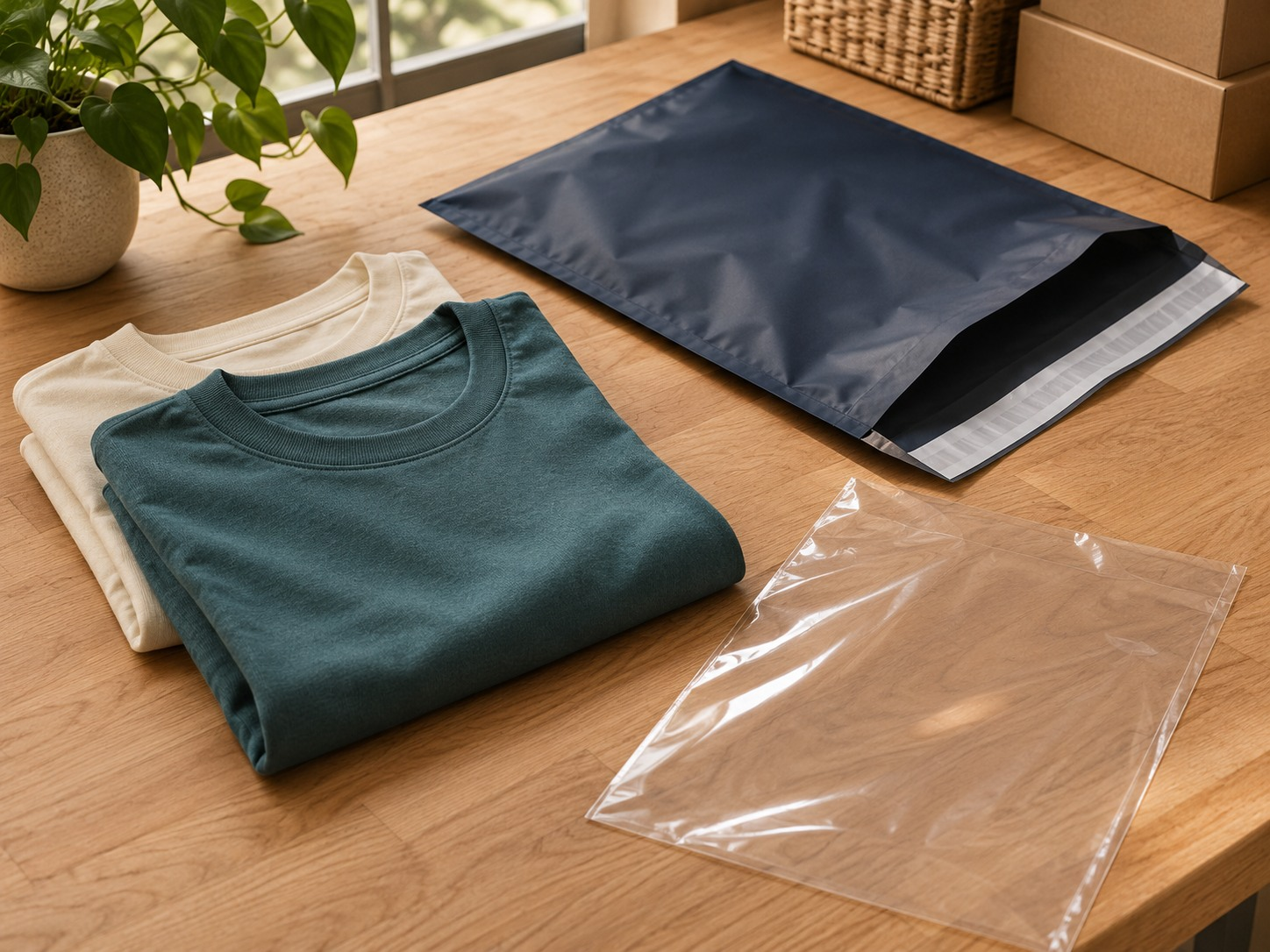
When an inner bag is worth adding
|
Situation |
Inner bag? |
Why |
|
Shirts picked or staged in shared totes with other sizes and colors |
Yes |
Bag plus size label keeps each variant folded and identifiable until it reaches the bench. |
|
White or light fabric, or a dusty pick route |
Yes |
Blocks dye transfer, dust and handling marks before the mailer goes on. |
|
Underwear, swimwear, socks, baby clothes |
Yes |
Buyers expect sealed, clean items, and a sealed bag keeps returns closer to resale condition. |
|
Marketplace or retailer requires bagging (for example, Amazon FBA apparel prep) |
Yes |
Follow the channel rule. Non-compliant units can be refused or charged a prep fee. |
|
Silk or other high-value pieces shipping in wet or humid weather |
Worth it |
Mailers shed rain but are not waterproof. A second layer covers a torn seam or pinhole. |
|
Premium or gift unboxing |
Optional |
A bag with tissue and a sticker adds presentation. |
|
High-return category |
Test it |
A resealable inner lets buyers repack cleanly. Compare your resale rate with and without. |
|
Single tee, hoodie or jeans, one SKU packed straight from an order slot, no channel rule |
No |
The mailer does the job. A second bag adds only cost and seconds. |
If you do bag, check the opening size. Larger clear garment bags commonly need a printed suffocation warning, and Amazon requires one on bags with an opening of 5 inches or more. Ask your bag supplier what the print should say.
What UPS and FedEx say
UPS’s clothing guide suggests an inner plastic bag inside a poly mailer for a new shirt, a correctly sized mailer for one pair of jeans, and a box for larger groupings. FedEx’s guide points to a mailer for a small shipment and a corrugated box for bulkier orders, with bagging as an optional step when boxing.
UPS’s double layer is a safe default for a new shirt, but it is guidance, not a ban on mailer-only shipping. Your carrier, service level and sales channel have the final say (carrier pages checked November 2026).
Choosing poly mailers for apparel
The mailer is the package you tender, so most failures start here.
- Thickness: 0–2.5 mil suits tees and light garments. Move to 3 mil for heavier items, or if you see tears in transit.
- Size: The mailer should be 1–2 inches (2.5–5 cm) wider than the folded garment, so the seal closes without strain. Common starting points are 10 × 13 in for a folded tee, 12 × 15.5 in for a light sweatshirt, and 14.5 × 19 in for jeans or heavier knits. Always test your own fold.
- Opacity: Co-extruded opaque poly mailers in white, gray or black hide the contents. Clear or thin film shows them, which matters for lingerie and for theft.
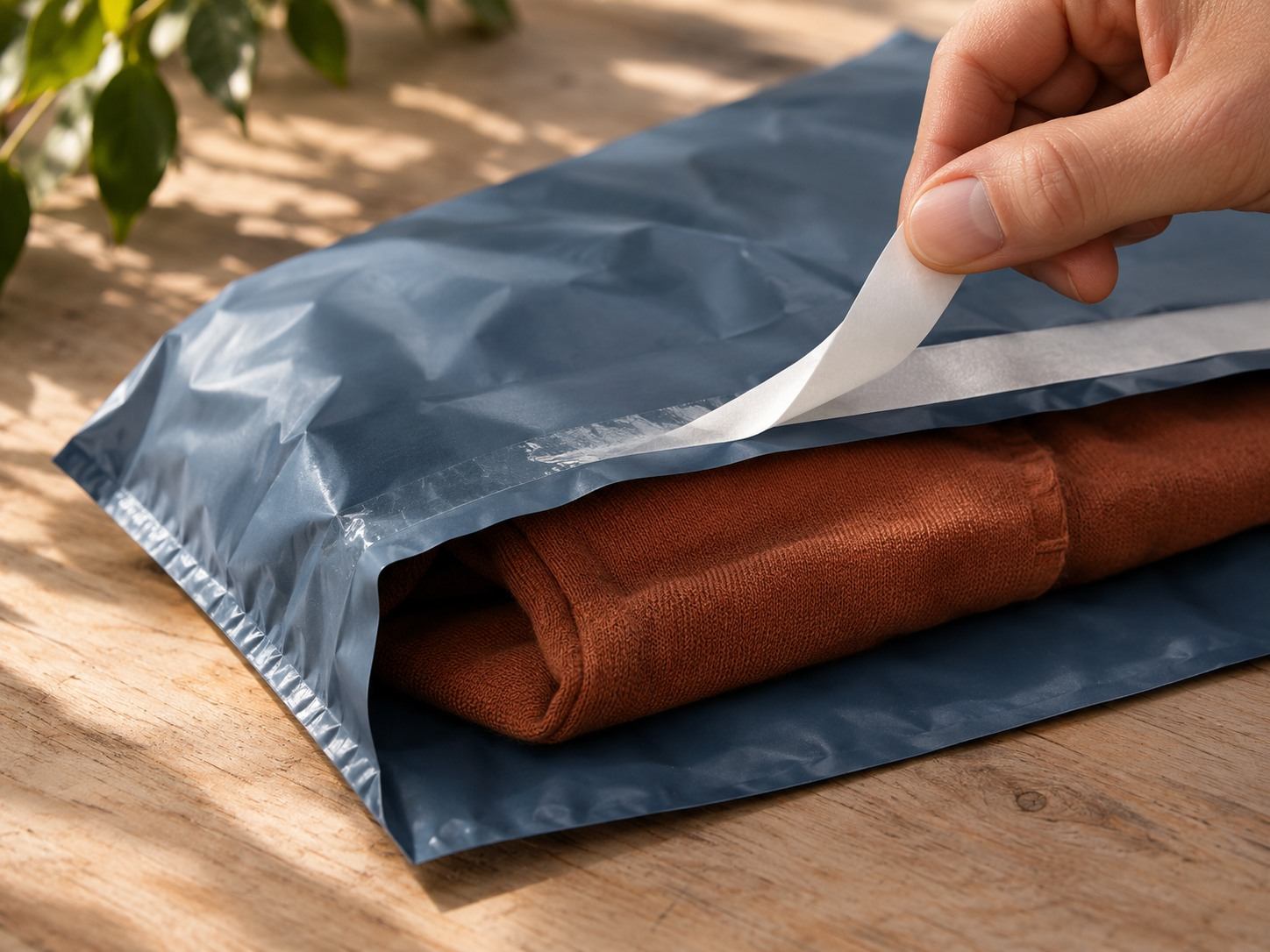
- Seal: A peel-and-seal strip only holds on a clean, flat surface. Keep the inner bag, any wrinkle of fabric and the label edge clear of it.
- When to switch to a box: Several bulky items, a thick hoodie, hard parts such as large buckles or rigid add-ons, or any pack you have to force shut. A second thin bag does not add structure, so change the outer.
What the inner bag really costs
A plain flat poly bag usually costs a cent or two. The larger cost is the packer’s time, often 3–5 seconds per unit. At 1,000 orders a day, that is roughly 50–80 minutes of labor. Time it at your own bench.
That cost pays off when the bag prevents one wrong-size shipment, one soiled shirt or one rejected unit, because each of those costs a reship or a return many times over what the bag does.
Test one shirt two ways
Take one cotton T-shirt, one mailer and one bench. Pack 20 each way.
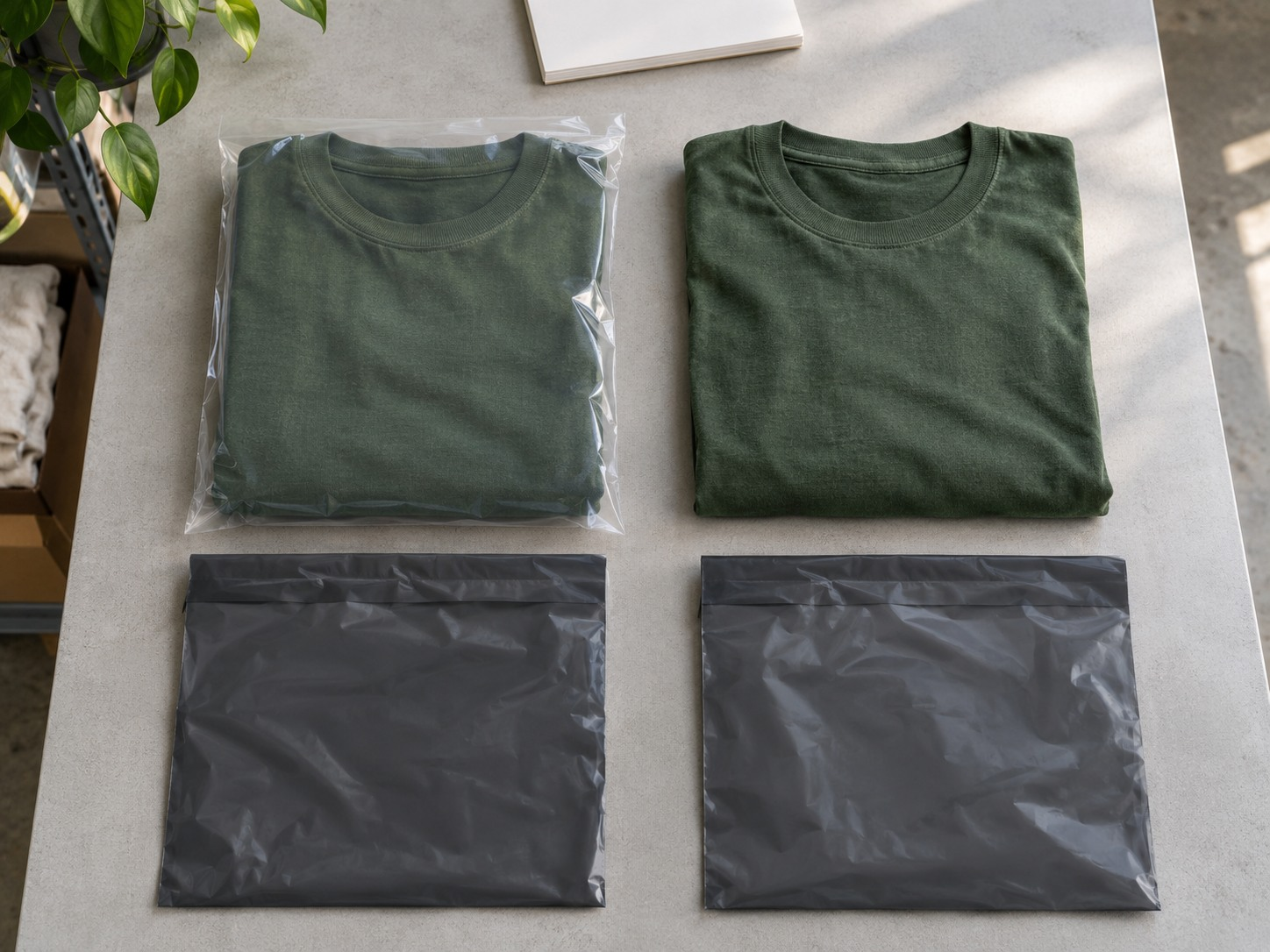
- Route A, shared totes: the shirt is bagged and labeled at pick, then goes into the mailer at the bench.
- Route B, dedicated order slot: the shirt goes straight into the mailer.
Record four things: seconds per pack, whether the seal closes flat, whether variants stay identifiable, and how the parcel looks when a few sample orders are shipped and opened like a customer would. If Route B holds up, drop the inner bag for that SKU. If the mailer fails any check, change the mailer before touching the bag.
Write the result into a pack instruction
Keep it to one line per SKU or order type: SKU → inner bag job (or none) → mailer size and thickness → who handles exceptions.
- Cotton tee, shared tote → 1 mil flat bag with size label → 10 × 13 in, 2.5 mil mailer → lead packer decides on a box if the seal won’t lie flat.
- Dark tee, dedicated slot → no inner bag → same mailer → lead packer.
If your return program uses a separate return pack, follow it and note it in the same line.
Get the mailer right
Huayuepack makes custom-printed poly mailers for apparel. Send us:
- the garment type and folded dimensions (length × width × thickness)
- your monthly or per-order volume
- whether you need custom printing
- any marketplace or return-pack requirement
PS: Not sure which thickness holds up for your heaviest SKU? Tell us what you ship and we’ll send a free sample kit to test on your pack bench.
We’ll recommend a mailer size and thickness and quote it. Use the contact form or email alfredren@huayuepack.com.
Packing Solutions
Related Products

Tel: +86 18019228135
E-mail: alfredren@huayuepack.com
Address: No.228 ZhaiXing Rd, XinSheng Industrial zone, ZheLin Town, FengXian District, ShangHai, China.

Copyright © 2026 Huayue Group Plastic Packaging Manufacturers
