
 English
 Español
Oversized Custom Poly Mailers: Shrink the Bag or Thin the Film First?
Open a packed order at the end of a shift. One folded T-shirt sits at the bottom of the mailer, and above it runs a long, empty tail of film, sealed and shipped anyway.
There are two obvious fixes: make the bag smaller, or make the film thinner. Both use less film. They don’t carry the same risk.
Short answer: if the bag has real empty space, shorten it first. You keep the same film and the same seal, so the only thing to verify is fit. Move to a thinner film only when the size is already right. And if your bags already tear or won’t close, fix that before you cut anything.
This article covers custom poly mailers made from plain PE film for soft, non-food apparel such as T-shirts and hoodies, packed by hand.
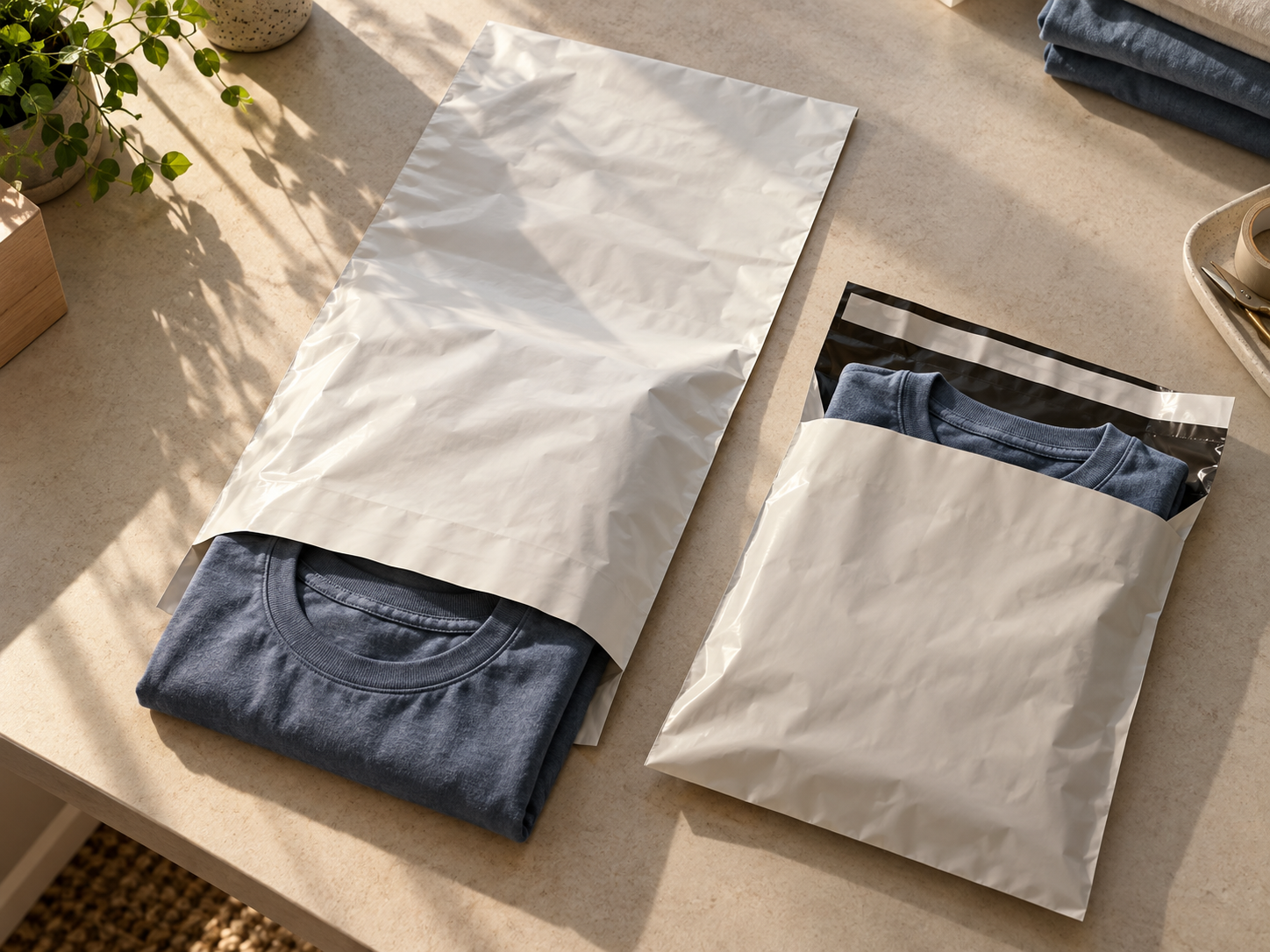
What each change saves
A mailer is two layers of film, so film weight is roughly 2 × width × length × thickness × density. Here is a standard 10 × 13 in mailer in 2.5 mil film (LDPE, about 0.92 g/cm³; flap and adhesive strip not counted):
|
Option |
Film per bag |
Change |
|
10 × 13 in, 2.5 mil (baseline) |
≈ 9.8 g |
— |
|
Shorten to 10 × 11 in, same film |
≈ 8.3 g |
−15% |
|
Keep 10 × 13 in, thin to 2.0 mil |
≈ 7.8 g |
−20% |
|
Both changes |
≈ 6.6 g |
−32% |
Three things stand out.
Thinner film looks better on paper, but it is the riskier change. A shorter bag needs a fit test. A thinner bag needs tear, puncture and seal testing.
A film saving is not a price saving. Printing, the adhesive strip, bag-making and carton packing don’t shrink in proportion, so the unit price will usually fall by less than the film does. Get a quote before you count the saving.
Don’t expect postage savings. A 1.5 g difference is nothing next to a 150–200 g shirt. The real savings are in the bag price, plus more bags per carton and less storage space.
For scale: at 20,000 mailers a month, 1.5 g less film per bag is 30 kg less film every month.
Step 1: Check that the slack is real
Start by matching your product to common stock poly mailer sizes. These are width × length, normally without the flap, so confirm with your supplier. Treat them as a rough guide, since fold and fabric weight change the answer.
|
Typical order |
Common mailer size |
|
Socks, underwear, small accessories |
6 × 9 in |
|
Thin folded top |
9 × 12 in |
|
Folded adult T-shirt |
10 × 13 in |
|
Two T-shirts, leggings, light sweatshirt |
12 × 15.5 in |
|
Hoodie, thick sweatshirt |
14.5 × 19 in |
|
Jacket, stacked jeans, bulky knitwear |
19 × 24 in |
Then run three quick checks:
- Measure the tail. Pack ten real orders and seal them. Measure the empty film between the garment and the sealing strip. As a rule of thumb, more than about 2 in (5 cm) of empty length on every order is worth shortening. Under 1 in is already tight.
- Test your bulkiest order. Use the largest size, the thickest fabric, and any insert you normally add. Slack that disappears here wasn’t slack.
- Look at the seal. The adhesive strip should lie flat across the full width, not stretch over a bulge. If packers have to fight to close the bag, it isn’t oversized.
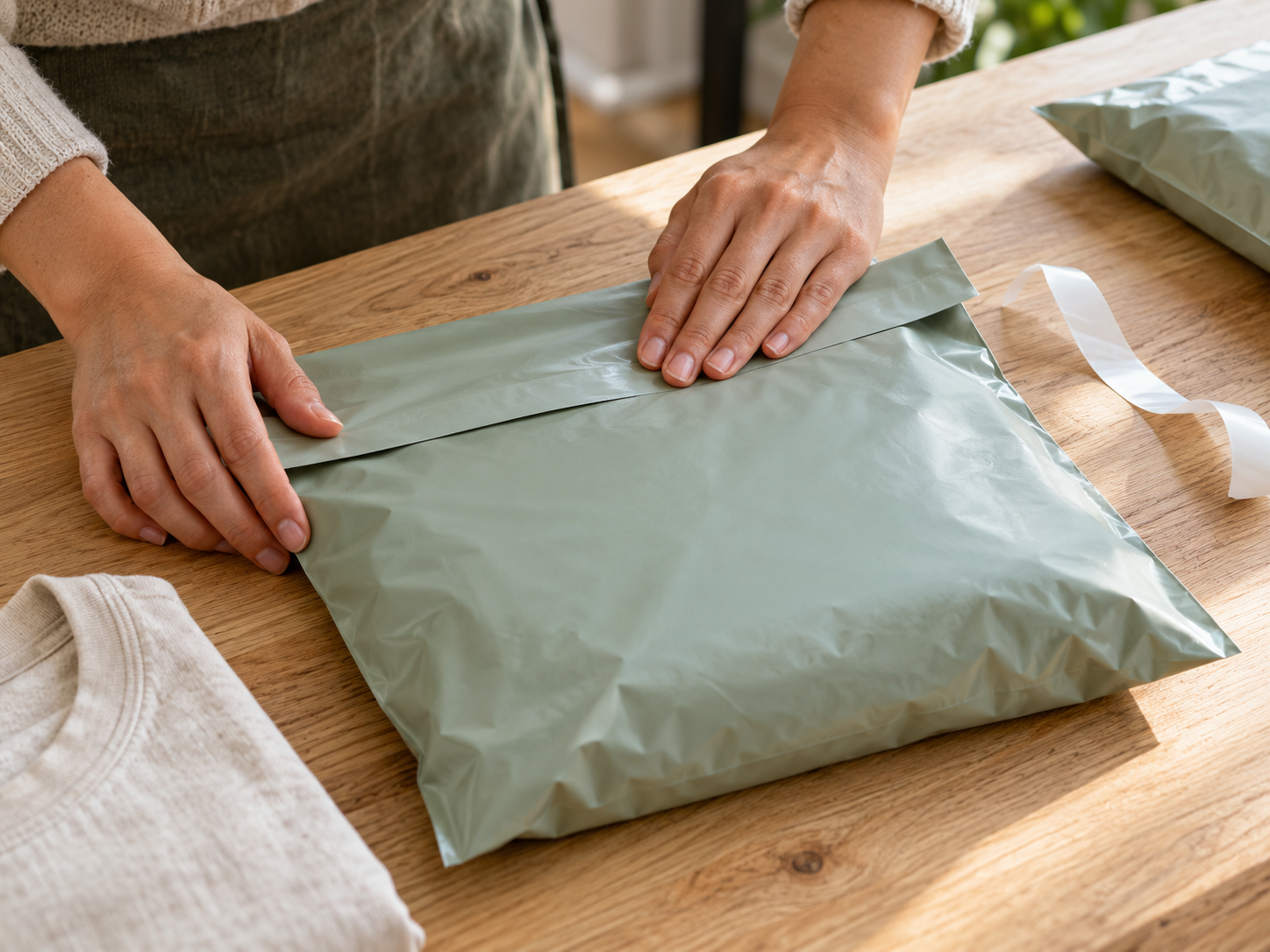
Step 2: Choose the first change
- Empty space on every order: shorten the bag. Cut the length by the measured slack minus about 1 in of margin, and keep the same film and seal.
- Empty space only on small orders, while bigger orders need the full size: add a second, smaller size for the small orders only. This pays off only if packers can tell the two sizes apart at a glance. Each extra size adds an SKU, splits your order quantity and adds stock to store.
- Size is already right, but you still want less film: ask for a lower gauge at the same size. Going from 2.5 mil to 2.0 mil (20% less film) is a common first step. Then test it.
- Bags already tear or won’t close, or orders include zippers, buckles or other hard parts: don’t cut anything. Find the cause first. You may need a stronger film, a different closure, or a different pack type.
- Supplier offers a bag that is both smaller and thinner: ask for two quotes, one size-only and one gauge-only. Otherwise you can’t tell which change is driving the price or any problems.
What to know before thinning the film
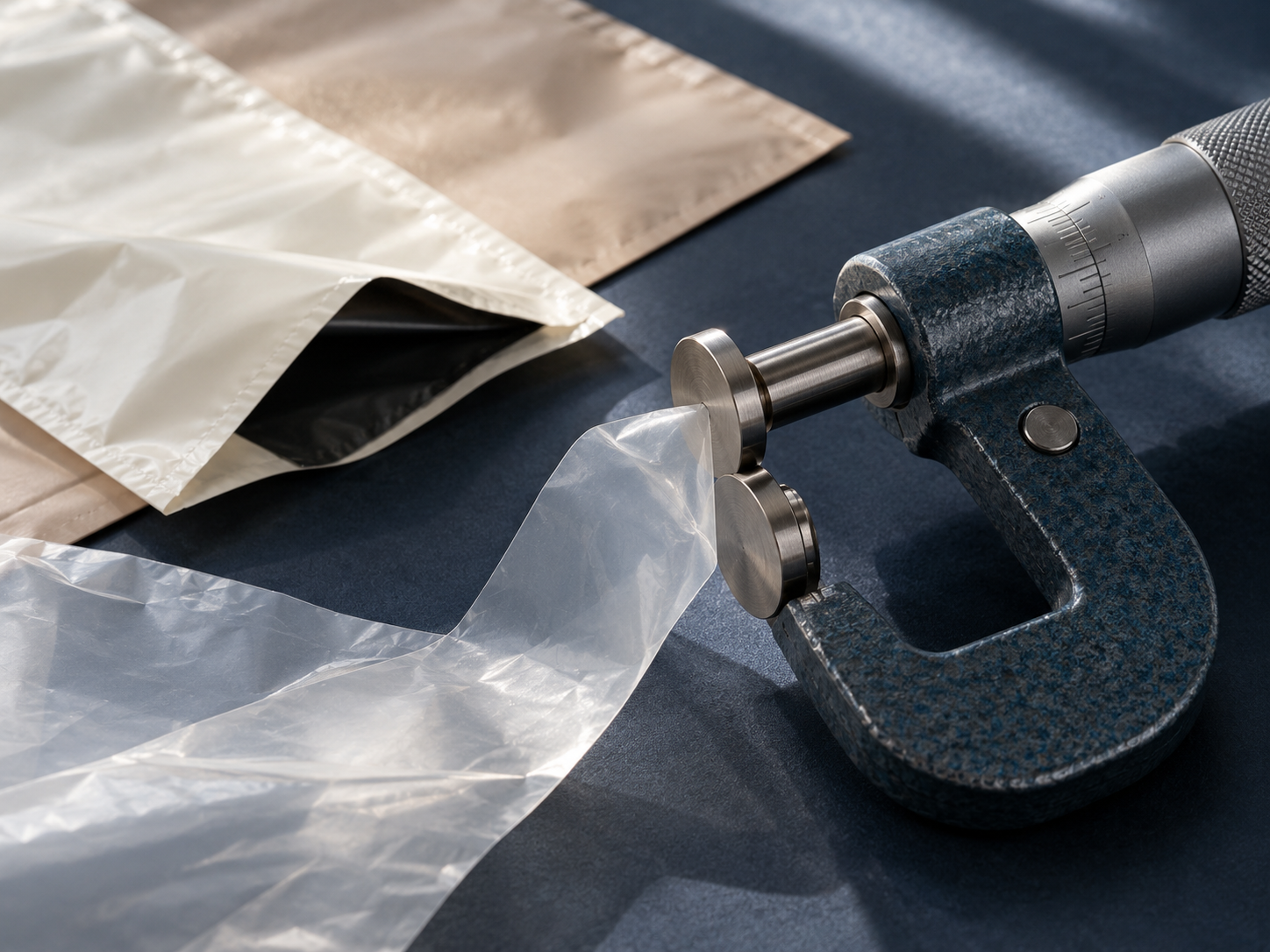
Most apparel mailers sit between 2.0 and 3.0 mil (about 50–75 µm), and 2.5 mil is the most common spec. One mil is 0.001 in, or 25.4 µm. Quotes may use mil or microns, so convert before you compare.
- Check the poly mailer thickness basis.Is it one layer or both layers combined? A mismatch can make a bag look twice as thick, or half.
- Ask about tolerance.Blown film commonly varies by about ±10%, so a 2.0 mil spec can measure anywhere from 1.8 to 2.2 mil.
- Thickness is not strength.Resin blend and co-extrusion structure matter as much. Thinner film from the same recipe loses tear and puncture resistance. Keeping the strength can mean a pricier resin blend, which eats part of the saving.
- Test the finished bag.Ask for tear resistance (ASTM D1922), dart impact (ASTM D1709) and seal peel results, then drop-test sample bags packed with real orders. If concealment matters, check opacity too, because thinner film can show the contents through. Our note on film specifications for custom poly mailers covers these in more detail.
Where the saving leaks
For custom printed mailers, a smaller bag usually means re-laying the artwork, and sometimes new printing plates. Leftover stock in the old size still has to be used up, so finish it before you switch or you pay twice. A second size adds another SKU to count, store and reorder. Weigh these against the film saving, and order samples before you commit to a full run.
Before you ask for a quote
Send your supplier:
- current finished size (width, length, flap)
- film specification and thickness basis
- photos of 3–5 packed orders with the seal closed
- closure needs (adhesive strip, resealable, tear strip, returns)
- yearly volume and destination
When quotes come back, compare them on the same quantity, print, packing and delivery terms. Approve a pre-production sample only after you have packed real orders with it.
Huayue makes custom poly mailers with logo and graphic printing. If you’re weighing a size or gauge change, send the details above through our contact form or to alfredren@huayuepack.com, and ask which change is worth testing for your orders.
Figures in this article are typical industry values for planning, not a guarantee for any specific bag. Confirm them with samples.
Packing Solutions
Related Products

Tel: +86 18019228135
E-mail: alfredren@huayuepack.com
Address: No.228 ZhaiXing Rd, XinSheng Industrial zone, ZheLin Town, FengXian District, ShangHai, China.

Copyright © 2026 Huayue Group Plastic Packaging Manufacturers
