
 English
 Español
Why Do Plastic Garbage Bags Split at the Bottom Seal?
A photo hits your inbox with a brief note: 'bottom split.' That tells you where the bag opened, but it doesn't tell you why. Did the seal fail? Did the film tear? Did the break start higher up? Each scenario points to a different manufacturing issue—and requires a different set of questions for your supplier."
The bag may have come apart inside the sealed band. The film may have torn right beside a band that held. Or the tear may have started higher up, in the bag body, and simply run down to the bottom. Each one points to a different problem, and each needs a different question for your supplier.
For plastic garbage bags, the first job is to work out where the break started. Everything else follows from that.
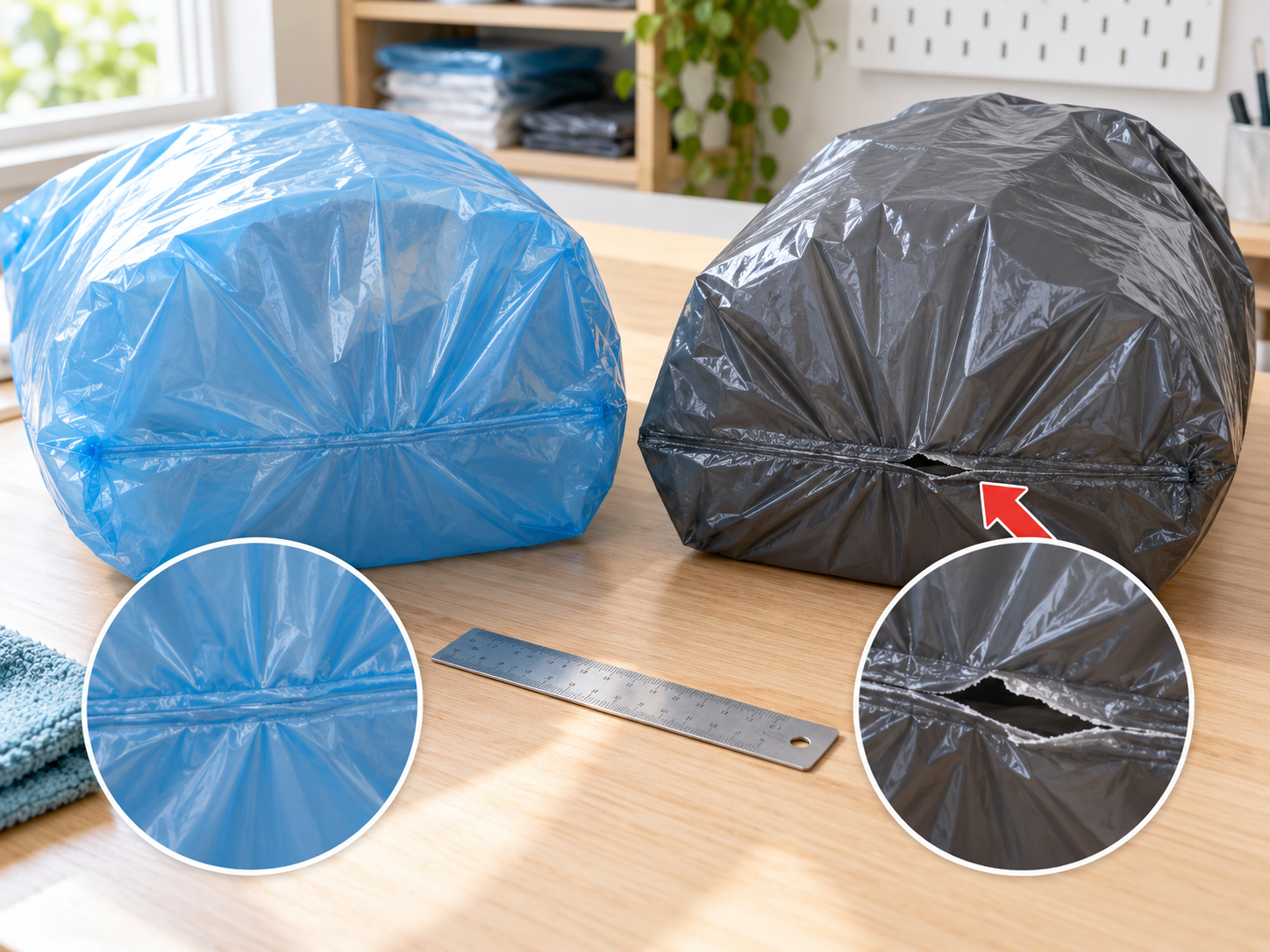
Step 1: Find where the break started
Lay the bag flat and look at the split before you touch it. Three things help:
- Follow the tear back. A tear in poly film usually fans out or curves away from where it began. Trace it back to the narrowest, sharpest point and look for a nick, a hole, a crease, or a hard edge there.
- Look at the seal faces. If the two layers simply came apart, the inside faces of the band often look flat and clean, with little stretched film. If the film tore, you'll usually see stretched, whitened, or ragged edges.
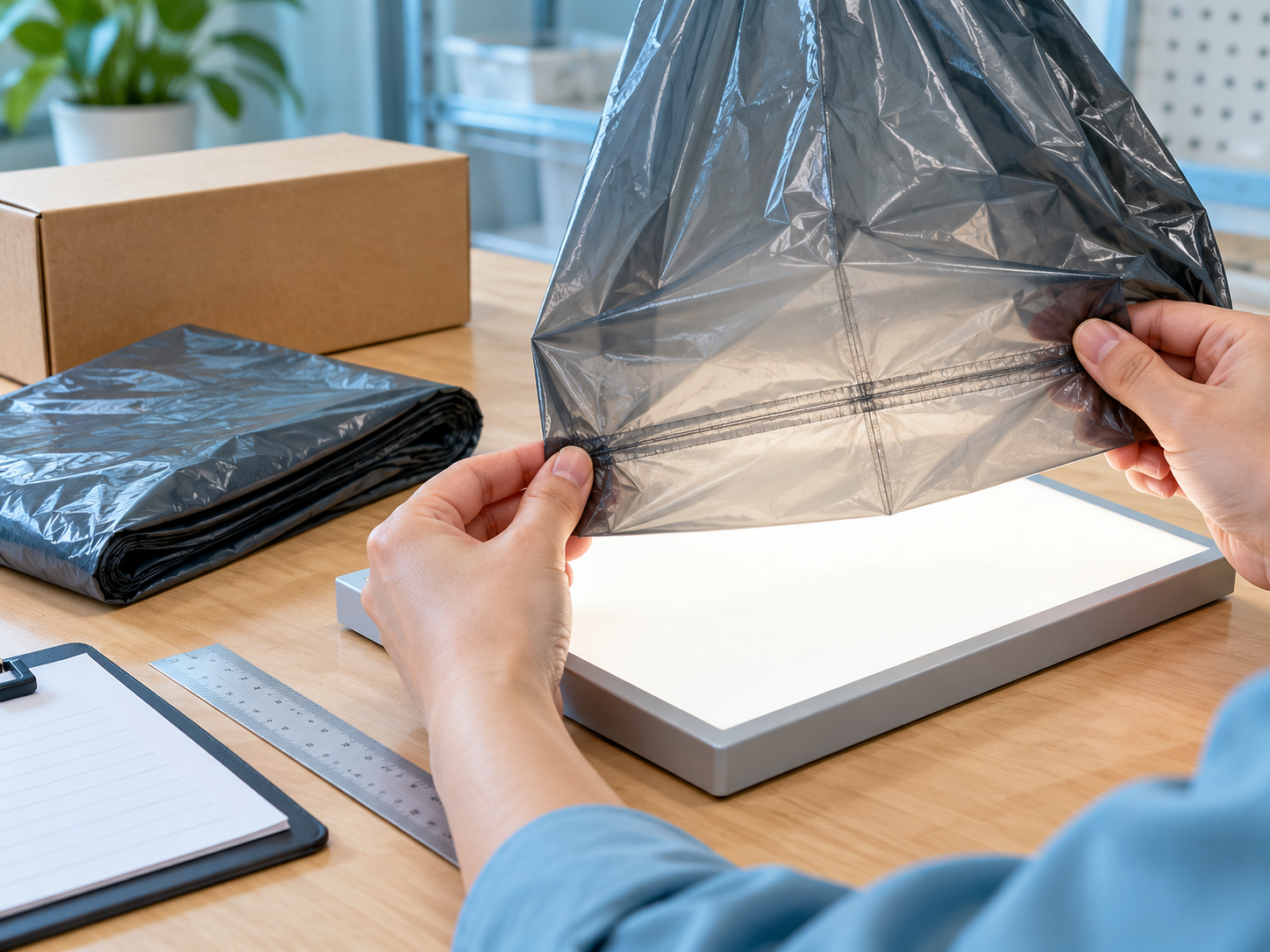
- Check the band itself. Hold the bottom seal up to a light. Wrinkles, gaps, dust, or product residue trapped in the band show up as dark or uneven lines.
Still can't tell? Write "unclear" and keep the bag. Don't force it into a category.
Step 2: Match what you see to a pattern
A. The two layers came apart inside the sealed band, and the film around it is fine.
- This bottom seal failure could point to:a gap or wrinkle in the seal, dust or product trapped in the band, or a seal that wasn't fully fused (temperature, pressure, or time).
- Also keep:close-ups of both faces of the seal, plus good bags from the same lot and from a different lot.
- Ask the supplier:Was the seal continuous at this spot? What were the sealing temperature, pressure, and time for this lot, and is there a record?
- Put in the spec:The bottom seal must be continuous, with no wrinkles, gaps, or trapped material, checked on a set number of bags per lot.
B. The seal held, but the film tore right next to it.
- Could point to:film thinned or weakened at the seal edge (sometimes from too much heat), uneven film thickness, a change in film formulation, or stress building up where sealed and unsealed film meet.
- Also keep:a whole-bag photo, a close-up of the tear along the seal edge, and torn and intact bags.
- Ask the supplier:How thick is the film at the seal edge compared with the body? Did the film formulation or resin lot change since the last good order?
- Put in the spec:Film material and thickness with a tolerance, and written notice before any formulation change.
C. The tear starts at a corner, fold, or gusset.
- Could point to:extra film layers at the junction, misaligned folds, or stress at the corners when the bag is lifted or dropped.
- Also keep:photos with the bag opened flat and filled the way you use it, and the bottom dimensions (width, gusset depth).
- Ask the supplier:Does this junction seal the same way every time on this bag format? Can you show a sealed junction from the current run?
- Put in the spec:The exact bottom construction (flat seal or gusset, gusset depth, seal layout), checked against the approved sample.
D. A slit or puncture starts in the bag body and runs down. The seal may be fine.
- Could point to:sharp or hard contents, snagging, dragging, rough handling, or film that's too thin for the load.
- Also keep:the object that caused it, the contact point, the full tear path, and a good bag for comparison.
- Ask the supplier:Where exactly did the tear begin? Does the same failure show up when you test with our actual contents?
- Put in the spec:The real contents and how they're handled, and test the sample that way. Don't just ask for a "stronger seal."
In plastic garbage bags, overloading, a bag size that doesn't suit the load, and cold storage that stiffens the film can all play a part, especially in heavy duty garbage bags. That's why the use conditions below matter.
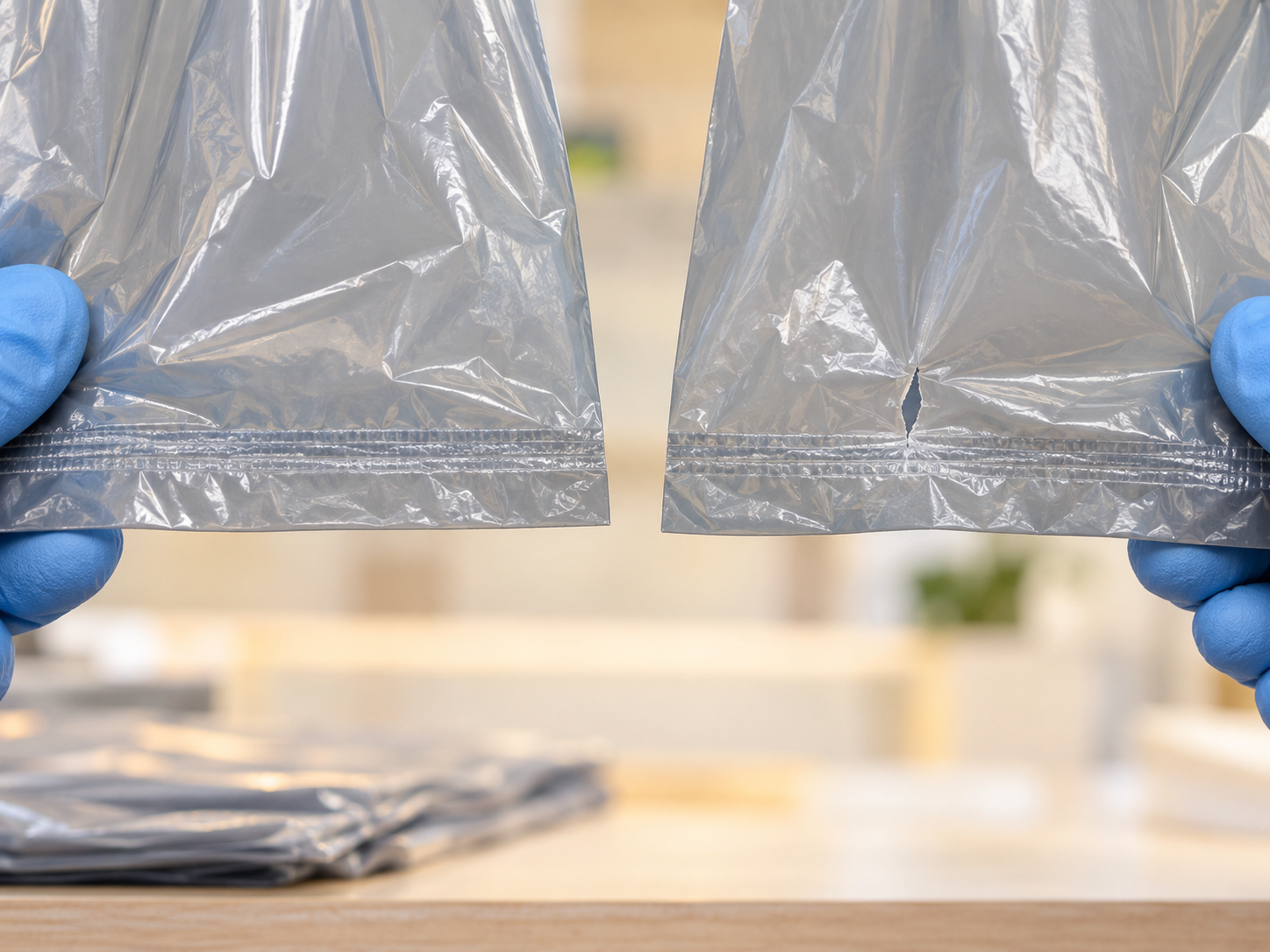
Step 3: Save the evidence before the bags get thrown out
- The bags. Keep failed and good ones, and don't pull the break further apart. If you can, keep about five of each. Take the good ones from the same carton as the failed ones, and a few from a different lot for comparison. Keep one unopened carton if possible.
- Photos. Four shots: the whole bag; both faces of the bottom seal laid flat next to a ruler; a close-up of where the break starts, with an arrow marking the direction; and the bottom seal held up to a light. Add a photo of the carton label.
- Identifiers. SKU or spec revision, lot number, carton number, production date, order number.
- Use conditions. What was in the bag and roughly how heavy, any sharp or hard items, how it was filled, how it was lifted (by the top, the handles, from underneath, dragged), and storage temperature and stacking.
- Timeline. When did it split: while filling, on the first lift, in transit, or after days in storage? When did it first appear, how many bags out of how many were affected, and did anything change (new lot, new supplier, new contents)?
Skip risky tests to "see what happens." A safe, well-photographed bag is worth more than a dramatic one.
Step 4: Send your supplier one case at a time
If you have two different failure patterns, send two separate emails. Here's a template:
Subject: Bottom seal split, [SKU], Lot [number]
Hi [name],
We found [X] bags out of [Y] split at the bottom, from lot [number] (carton [number], produced [date]).
What we see: [the two layers came apart inside the seal / the film tore beside the seal / the tear starts at the corner / the tear starts in the body]. The break appears to start at [location, see photo].
How it happened: [while filling / on lifting / in transit / in storage]. Contents: [what, approx. weight]. [Any sharp items.]
Attached: whole-bag photo, both faces of the seal with a ruler, a close-up of the break, and a good bag from the same carton. We're keeping [X] failed and [Y] good bags and can ship them to you.
Could you tell us:
- Was the seal continuous at this spot?
- What were the sealing temperature, pressure, and time for this lot?
- What is the film thickness at the body and at the seal edge?
- Has anything changed in the film or the setup since the last good lot?
- What would you suggest we test next.
What a photo can't tell you
A photo can't prove the root cause of a bottom seal failure. A lab seal-strength number describes a strip cut from the seal, not the whole bag with your product in it. So, the last step is always a trial with the real bag, the real contents, and the real handling. What the steps above do is get you to that trial with the right question.
Send it to us
Dealing with bottom splits in plastic garbage bags, including flat-seal or gusseted garbage bags? Send us the evidence through our contact page or at alfredren@huayuepack.com, and we'll go through the failure with you and what to check in the next sample. Please include:
- Photos of the failed and good bags, showing the full bottom and the break.
- Bag format, size, and order or lot number, plus material and thickness if you know them.
- What was in the bag, and how it was filled, lifted, and stored when it failed.
Packing Solutions
Related Products






Tel: +86 18019228135
E-mail: alfredren@huayuepack.com
Address: No.228 ZhaiXing Rd, XinSheng Industrial zone, ZheLin Town, FengXian District, ShangHai, China.

Copyright © 2026 Huayue Group Plastic Packaging Manufacturers
