
 English
 Español
Restaurant Kitchen Trash Bags: How to Match the Liner to Wet, Heavy, and Sharp Waste
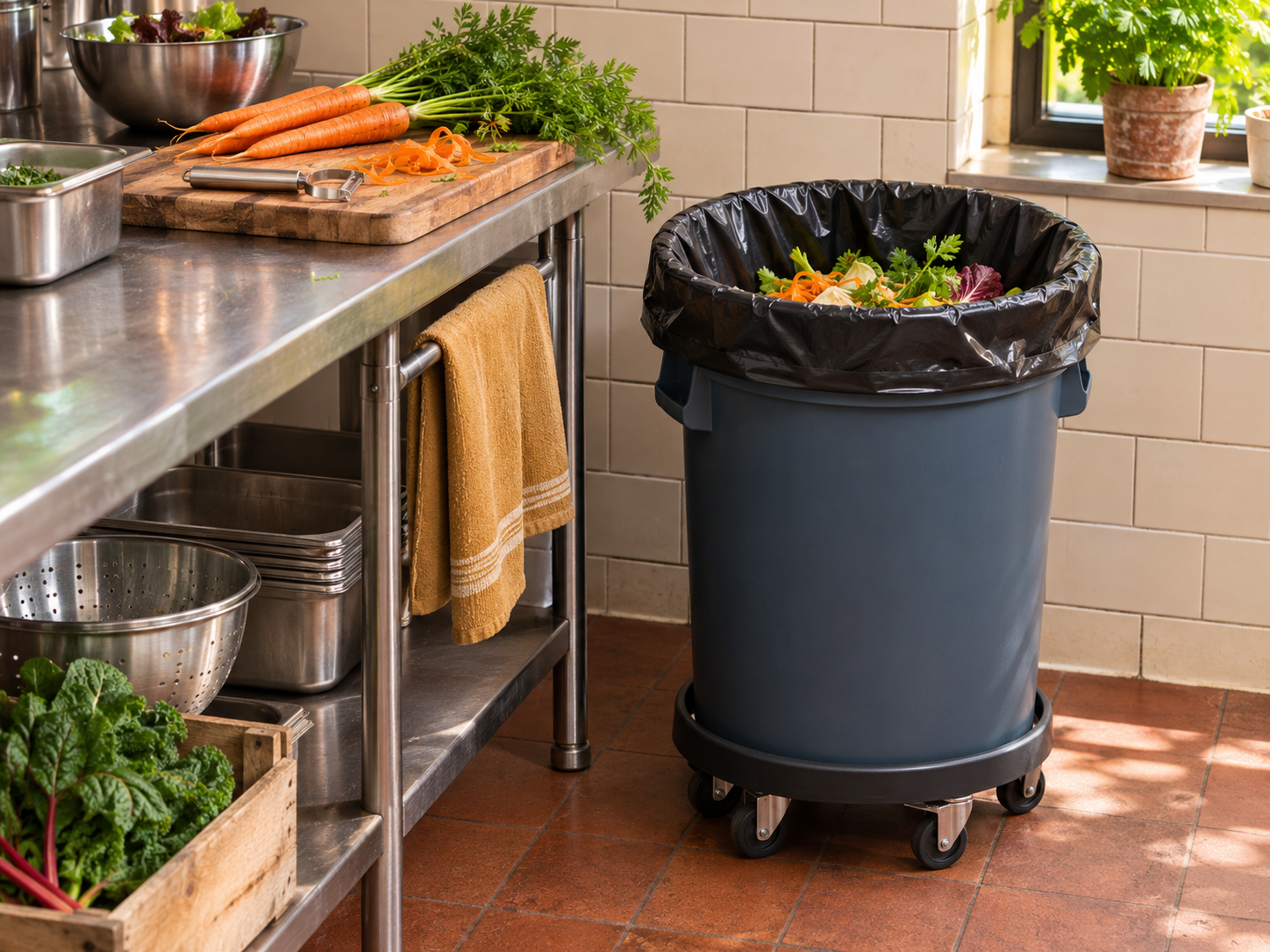
Ordering restaurant kitchen trash bags in a single “heavy-duty” spec usually ends one of two ways: you overspend on thick plastic for dry paper bins, or you deal with split seams and blown-out corners on the nightly dumpster run.
Prep stations generate wet vegetable trim, the dish pit turns out dense plate scrapings, and the receiving door piles up rigid plastic trays and broken-down boxes. Because each station stresses polyethylene film differently, matching the liner spec to the bin saves money on film while cutting down on double-bagging and floor cleanups. This guide covers how to match resin, thickness, and bottom seals to each kitchen station, how to size bags so they neither slip in nor balloon out, and how to audit supplier specs before ordering by the pallet.
(Note on kitchen exceptions: No polyethylene liner—regardless of thickness—is built for hot fryer oil, uncooled stockpot waste, or loose broken glass and blades. Keep sharps in rigid puncture-resistant containers, pour free liquids down approved drains or grease traps, and let hot waste cool so it doesn’t soften the film and weaken the bottom seal.)
1. Match the Resin and Thickness to the Station
When comparing supplier spec sheets, ignore marketing labels like “Extra Heavy” and look straight at two numbers: resin type and gauge (thickness).
In the US market, LLDPE and low-density blends are measured in mils (1mil=0.001inch≈25.4μm), while high-density (HDPE) bags are usually measured in microns (μm).
- HDPE (High-Density Polyethylene): Crisp, crinkly, and sold thin (typically 10–16μm). It has high tensile strength and handles weight well at a low cost, but once punctured by a sharp edge, it zippers open rapidly. Best kept out of the back-of-house kitchen and used in restrooms, offices, or dry front-of-house bins.
- LLDPE (Linear Low-Density Polyethylene): Softer, quieter, and stretchy. Instead of tearing when snagged by a bone or tray corner, LLDPE stretches around the object. LLDPE trash bags are the standard choice for commercial kitchens.
Use these baselines to set up your kitchen stations:
|
Kitchen Station |
Typical Contents |
Recommended Spec |
Common Failure Mode |
|
Front-of-House / Restroom |
Napkins, paper towels, cups |
HDPE 12–16μm or LLDPE 0.7–0.9mil |
Overspending on thick kitchen liners |
|
Prep Tables |
Wet peels, vegetable trim, meat wrappers |
LLDPE 1.1–1.5mil (28–38μm), Star Seal, 33–45gal |
Liquid pooling and leaking at the bottom corners |
|
Dish Pit / Bus Station |
Dense plate scrapings, coffee grounds, rinds |
LLDPE 1.3–1.7mil, Star Seal, in a ≤32gal wheeled bin |
Bag holds, but a full 44-gal bin exceeds 100lbs and injures staff during lift-out |
|
Receiving / Meat & Seafood |
Bones, shells, rigid plastic trays, box corners |
LLDPE 1.5–2.0mil (38–51μm), Star Seal |
Side-wall punctures and long tears during carry |
Pro Tip on Virgin vs. Recycled Content (PCR/Regrind): Bags extruded with high percentages of post-consumer recycled (PCR) or factory regrind resin often look thicker on paper but lose stretch and puncture resistance. A 1.2mil virgin LLDPE bag frequently outperforms a 1.5mil high-regrind bag when loaded with sharp bones or crab shells.
2. Choose the Right Bottom Seal
Where a bag leaks matters as much as where it tears. Commercial liners use one of three bottom seals:
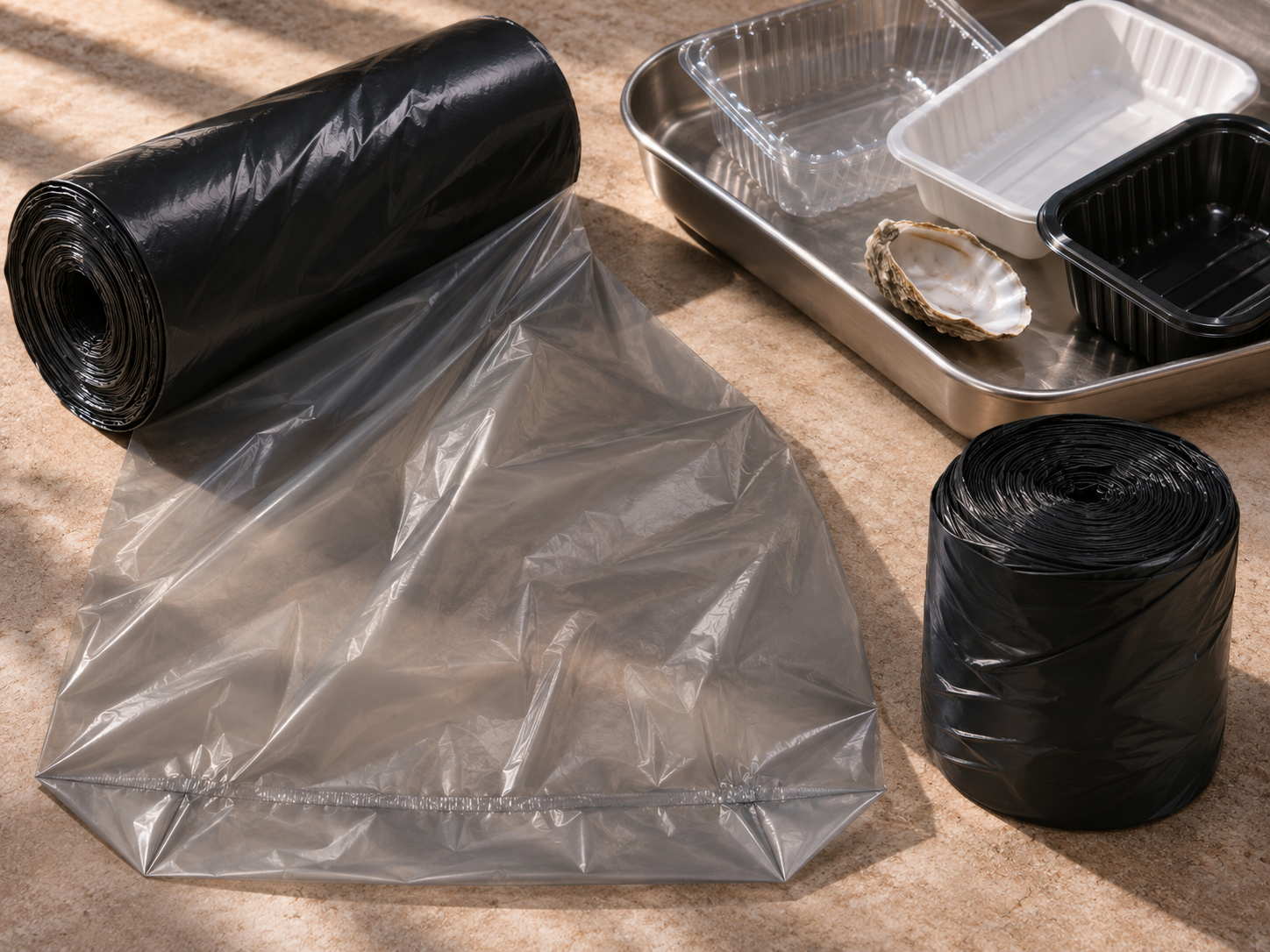
- Star Seal (The Kitchen Standard): The film is folded into a star shape at the base and sealed at a single center point. Because there are no wide corner seams, the bag conforms smoothly to round or square bins, distributes liquid weight evenly, and eliminates corner leaks. Specify star seal trash bags for all wet and heavy stations.
- Flat Seal: A straight heat seal across the bottom, like a pillowcase. While strong, flat seals leave two ears at the bottom corners where meat juices and sauces pool and eventually burst through. Keep flat seals for dry waste or flat packaging.
- Gusseted Seal: The sides are tucked in to form a flat, box-like bottom, with four layers of film sealed on the sides and two in the middle. Under wet loads, the transition point between two and four layers is prone to pinholes.
3. Size the Liner to the Bin (Without Wasting Film)
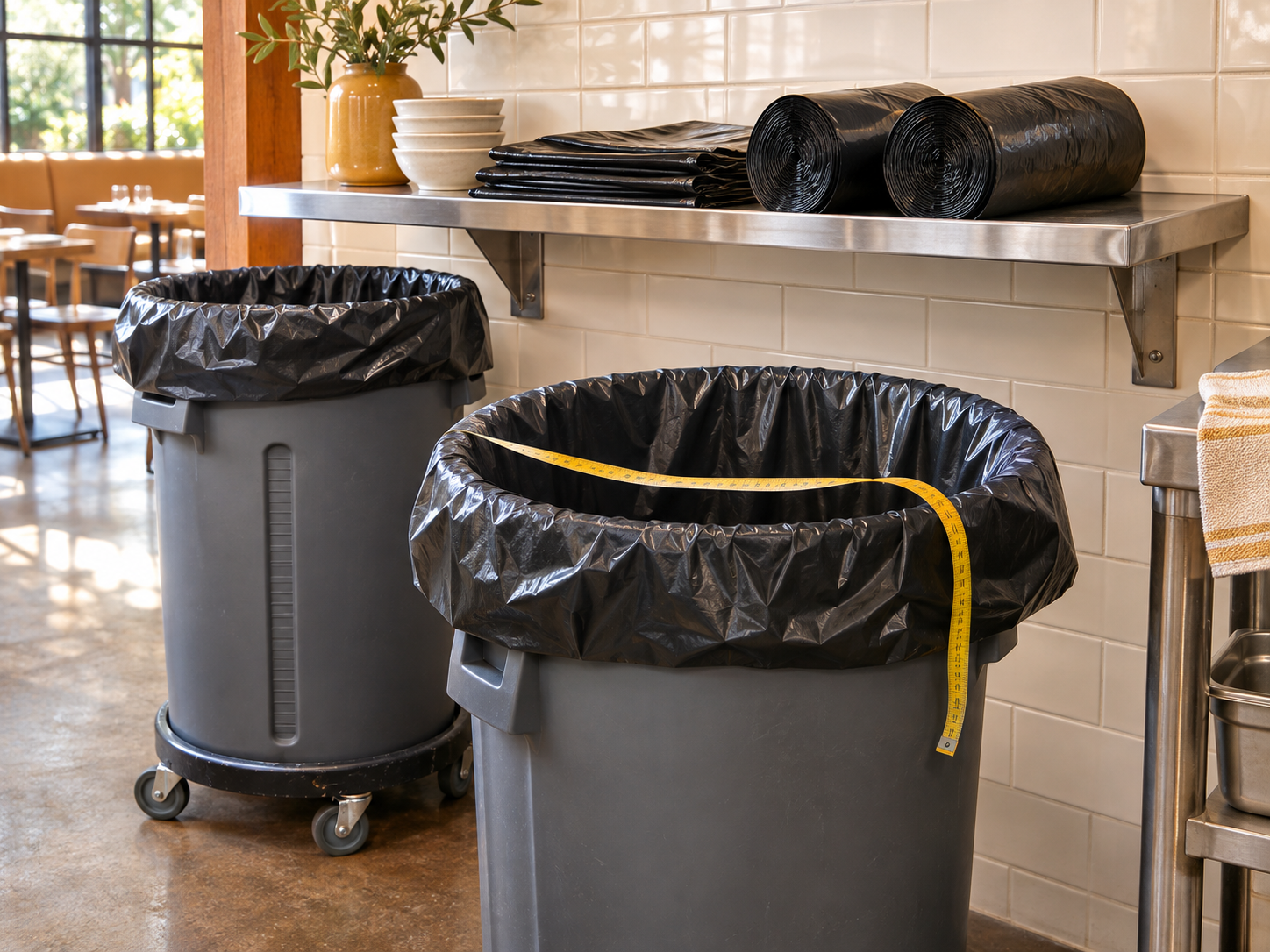
A liner that is too narrow stretches taut over the rim, snaps inward under the first heavy load, and leaves no slack to tie shut. A liner that is too wide bunches up at the collar and inflates your cost per bag.
Calculate the exact flat dimensions in inches before looking at nominal gallon ratings:
- Bag Width = Bin Circumference÷2.
- Round bin: (Diameter×3.14)÷2.
- Square or rectangular bin: Length+Width.
- Bag Length = Bin Height+½Bin Diameter (or ½ the shortest side of a rectangular bin) +5to6inches for overhang and tying.
Quick-Sizing Example: For a standard round prep bin measuring 20in wide by 24in tall, the circumference is 62.8in. Divide by 2 to get 31.4in (round up to the nearest stock width: 33in). For length, add 24in (height) +10in (half the diameter for bottom coverage) +5in (overhang) = 39in (round up to 40in). Your target spec is a 33×40in liner.
|
Nominal Bin Capacity |
Standard Stock Liner Size (in) |
Typical Kitchen Use |
|
20–30gal |
30×36 |
Under-counter prep, compact dish return |
|
32–33gal |
33×40 |
Standard prep stations, line bins |
|
40–45gal |
40×46 |
Receiving door, high-volume bulky waste |
|
55–60gal |
38×58 |
Back-corridor consolidation drums (dry/light only) |
4. Solve the Dish-Pit Lift Problem
When dish-pit bags tear at the top, buying a 2.0mil bag rarely fixes the root problem. A 44-gallon or 55-gallon barrel packed to the rim with wet food waste easily tops 100lbs (45kg)—nearly double the 51-lb (23kg) NIOSH lifting benchmark for ideal conditions. Furthermore, wet waste creates a vacuum seal inside deep, smooth-walled bins, forcing kitchen staff to yank the collar until the plastic stretches and rips.
Three operational tweaks save both your liners and your staff’s backs:
- Downsize wet bins to 32gallons or less: Keep 44+ gallon bins strictly for bulky, lighter packaging. At the dish pit, a 32-gallon bin on a wheeled dolly caps the max weight at a manageable load.
- Break the vacuum: Use vented trash cans (with built-in air channels along the sides), or drill two small 1/2-inch air holes near the bottom side of standard plastic barrels (above the liquid catch line) so bags slide out without suction resistance.
- Match the closure to the route: Flat-top bags (tied in a knot or with a twist-tie) are the most cost-effective per case, provided you leave 6inches of overhang. If staff have to carry bags down stairs or across long parking lots to the dumpster, drawtape liners speed up closing and provide a reinforced carrying handle.
5. Five Specs to Demand From Your Supplier
Before locking in a contract or ordering custom pallets, ask your manufacturer or distributor for these five items to ensure you are comparing apples to apples:
- Net Case Weight (The Ultimate Honesty Check): Always ask for the net weight of the case (excluding the cardboard box) alongside bag count and dimensions. Because polyethylene is sold and extruded by weight, a supplier quoting a “1.5 mil” bag at 14lbs per case of 100 is giving you less plastic than a supplier quoting the same size and count at 17.5lbs.
- Actual Gauge Tolerance: Industry standards allow thickness variations, but budget suppliers often run at the very bottom of the tolerance window (e.g., delivering 1.1mil film on a 1.3mil label). Ask for guaranteed minimum gauge, especially along the gusset folds and bottom seal.
- Finished-Film ASTM Test Data: Ask for Dart Drop Impact (ASTM D1709) to measure puncture resistance against bones and corners, and Elmendorf Tear (ASTM D1922) to measure how well the film resists zipping open once nicked. Ensure the numbers reflect the blown film, not just the raw resin pellet datasheet.
- Roll vs. Flat-Pack Dispensing: Decide whether your staff moves faster with coreless interleaved rolls (stored at the bottom of the bin so the next bag pulls up automatically when the full one is lifted out) or flat-packed dispenser cartons mounted on the wall.
- Compostable Certifications & Shelf Life (If Required): Where local haulers mandate compostable liners for food scraps, confirm ASTM D6400 (US) or EN 13432 (EU) certification. Because PLA/PBAT compostable blends lose strength over time in hot, humid storage rooms, order them on shorter, rotating lead times rather than warehousing a year’s supply.
Sample Three-Bin Kitchen Spec
For most commercial kitchens, standardizing restaurant kitchen trash bags down to two or three core SKUs hits the sweet spot between inventory simplicity and cost control:
- SKU 1 — Prep & Dish Pit (32-gal wheeled bins): 33×40in Virgin/High-Grade LLDPE, 1.3mil, Star Seal, Coreless Roll.
- SKU 2 — Receiving & Back Door (44-gal bins): 40×46in LLDPE, 1.6mil, Star Seal, for rigid trays, meat packaging, and sharp corners (flatten cardboard separately for recycling).
- SKU 3 — Front-of-House & Restrooms: 30×36in or smaller HDPE (13μm) for light paper waste.
Benchmark Your Current Liners With Huayuepack
Not sure if you are overpaying for film thickness—or getting shortchanged on case weight? Huayuepack manufactures custom and stock commercial can liners tailored to foodservice distributors, restaurant groups, and facility buyers.
Send a photo of your current carton label or spec sheet (or just your bin sizes, typical waste load, and monthly volume) to alfredren@huayuepack.com, or reach out via Huayuepack’s Garbage Bag Page. Our engineering team will calculate your current cost-per-bag by net resin weight, recommend an optimized film and seal match, and ship sample rolls to test on your busiest weekend shifts.
Packing Solutions
Related Products

Tel: +86 18019228135
E-mail: alfredren@huayuepack.com
Address: No.228 ZhaiXing Rd, XinSheng Industrial zone, ZheLin Town, FengXian District, ShangHai, China.

Copyright © 2026 Huayue Group Plastic Packaging Manufacturers
