
 English
 Español
The Ultimate Guide to Baby Diaper Plastic Packaging Bags - Materials, Types & Sourcing
Every diaper brand relies on one thing to protect its product from factory to shelf - packaging. Diaper Plastic Packaging Bags are the final layer standing between a soft, absorbent diaper and moisture, dust, and damage during shipping and storage. This guide covers why packaging matters, the main bag types, and how to choose the right supplier.
Why Packaging Quality Matters
Parents judge a diaper brand before they even open the bag. A crumpled, thin, or poorly sealed bag signals low quality, even if the diaper inside is excellent. Poor packaging also creates real risk - weak seams burst during transit, thin film lets moisture in, and dull printing gets lost on a crowded shelf. Good Baby Diaper Plastic Packaging Bags solve this at once — protecting the product from moisture and contamination, adding convenience through handles and resealable closures, and carrying the brand through vivid printing and premium finishes that build recognition at the point of sale.
Materials and Barrier Structure
Most premium Baby Diaper Plastic Packaging Bags use a BOPP/PET/CPP laminated structure, combining the strengths of each layer - BOPP delivers a smooth, high-gloss surface for vivid printing; PET adds strength and puncture resistance for safer handling and transit; and CPP forms the inner sealing layer, providing reliable heat-sealability and a strong moisture barrier.
This lamination is what makes the bags genuinely moisture-proof, keeping diapers dry and hygienic from factory to shelf. Brands can choose a fully opaque finish for stronger UV and light protection, or a translucent option that lets parents see the product inside — building trust while still guarding against moisture and contamination. Film thickness and layer ratios can also be adjusted to balance cost, durability, and shelf appeal, giving brands flexibility to match performance with pack size and market positioning.
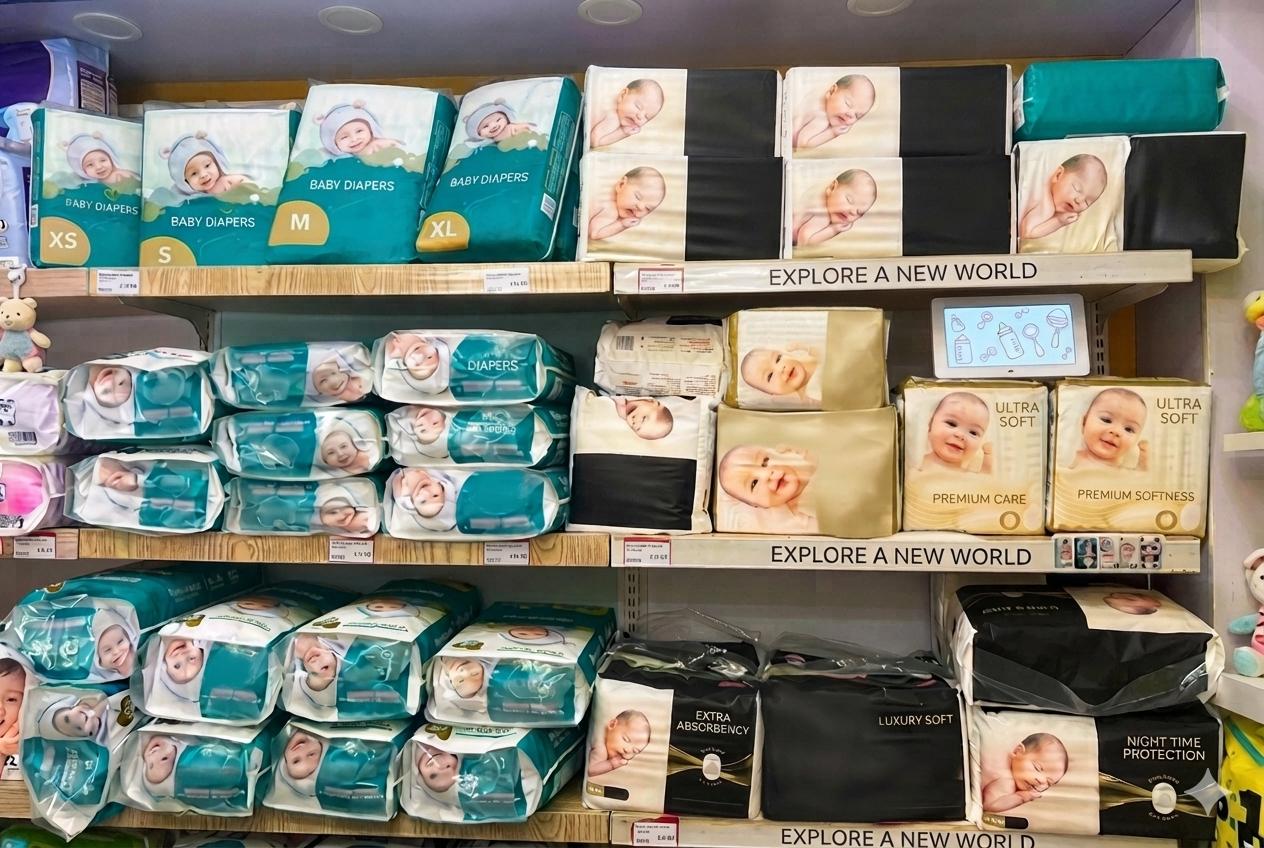
Common Types of Diaper Packaging Bags
Diaper packaging is best classified by bag shape, since this determines volume capacity, shelf stability, and production tooling.
Flat (Pillow) Bags
No gussets — heat-sealed on three or four sides, the lowest-cost option. Suited to trial packs (8–20 diapers) or export bulk; lowest MOQ, fastest turnaround.
Side-Gusset Bags
Gussets fold only at the sides, expanding the bag's width without adding a standing base — a slimmer profile than a bottom-gusset design. Common for compact-to-mid packs (20–40 diapers) or incontinence products, 50–70 micron film, 200–320mm width.
Bottom-Gusset (Block-Bottom) Bags
Folded panels at the base expand and seal flat, letting the bag stand independently — giving a structured shelf presence and the largest volume capacity of the three formats. Used for mid-range, premium, and jumbo packs (30–80 diapers), 60–120 micron BOPP/PET/CPP laminate. Width range -300–450mm, 80–120mm gusset depth. Requires a dedicated forming line, so MOQs run higher (5,000–10,000 units).
Optional Features (All Shapes)
- Handles - die-cut, patch, or rope, for packs over 30 diapers; adds carrying convenience and print surface.
- Zip-Lock - resealable strip for trial/travel packs used over multiple sessions.
- Easy-Tear Opening - laser-scored line for simpler first-time opening.
The right combination depends on pack size, retail channel, and cost targets. A good Diaper Plastic Packaging Bags Factory recommends the optimal fit rather than a one-size-fits-all solution.
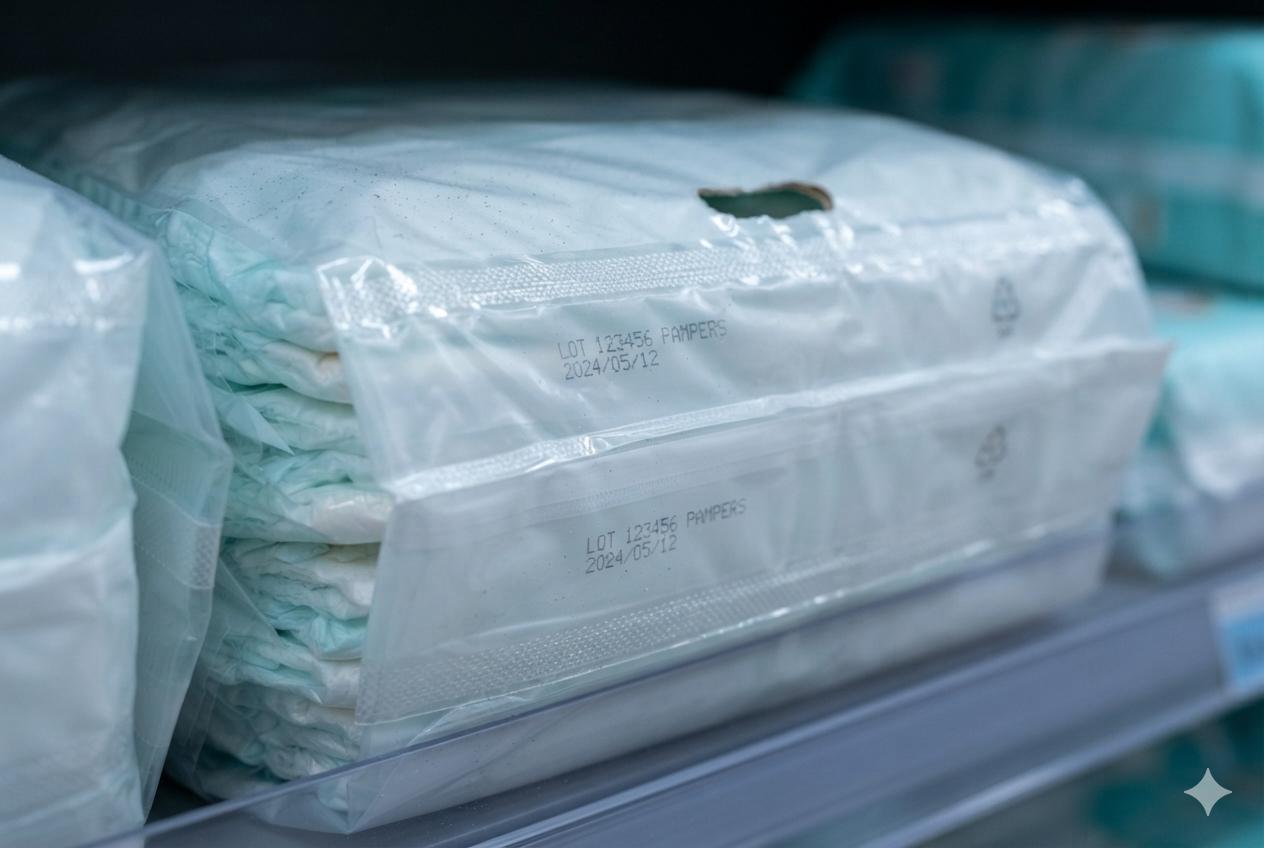
How to Choose the Right Manufacturer
Sourcing from reliable Diaper Plastic Packaging Bags Manufacturers shouldn't rest on vague claims of reliability. Brands should request objective, testable data against five criteria before committing to a supplier.
- Lamination Integrity and Moisture/Seal Barrier
Ask for the water vapor transmission rate (WVTR), typically below 3–5 g/m²/24h for a BOPP/PET/CPP structure at 38°C/90% RH. Request bond strength reports — a well-laminated film should hold above 2.5 N/15mm without delamination. Seal integrity should be verified with a dye-penetration or bubble-leak test on finished bags, not just flat film. - Dimensional and Thickness Tolerance
Confirm tolerance on bag width/length (commonly ±2mm under 400mm) and film gauge (typically ±5% of nominal micron thickness, measured across the roll). Ask how gauge variation is controlled within a single batch. - Post-Fill Seal, Drop, and Compression Testing
A credible supplier tests bags after filling with actual diapers. Request seal peel-force data (≥15–20 N/15mm for CPP seals), a drop test (e.g., ISTA 1A, 1–1.2m, multiple orientations), and a compression test simulating 3–5 stacked master cartons. - Print Registration, Rub Resistance, and Batch Color Consistency
Ask for print registration tolerance (commonly ±0.5mm across colors) and rub-resistance data (100+ cycles on a Sutherland tester without visible wear). For batch consistency, request Delta E (ΔE) readings — under 2.0 is visually consistent; above 3–4 is noticeable and risks brand inconsistency. - Unit and Master-Carton Pack-Out, and Repeat-Order Control
Confirm units-per-bag and bags-per-carton configuration, with a pack-out sheet showing carton dimensions and gross weight. For reorders, ask how approved artwork, Pantone references, and film specs are archived so packaging matches the original sample months later.
Customization and Quote Specifications
Once a bag shape is chosen, getting an accurate quote depends on how completely the order is specified. Submit the following to move from inquiry to sample production without back-and-forth revisions -
- Diaper count and pack dimensions - diapers per bag (e.g., 40-count) and target external dimensions (L × W × gusset depth in mm), or the diaper's folded size for the factory to calculate fill allowance.
- Artwork and colors - print-ready files (AI/PDF, vector) with Pantone references per spot color, or the number of colors/print method (spot vs. CMYK) if artwork isn't finalized.
- Bag format and optional features - shape (gusseted, flat-bottom, side-gusset, or flat), plus any handle type, zip-lock closure, or easy-tear opening, and film thickness if there's a target barrier requirement.
- Order volume and destination - quantity, trial vs. repeat order, and destination market, since import rules (e.g., minimum film thickness) can affect material choice.
Huayue Group supports customization across film thickness, bag width, bag length, base color, and full custom printing — each adjustable independently to match pack size, barrier needs, and shelf positioning, rather than fixed template sizes.
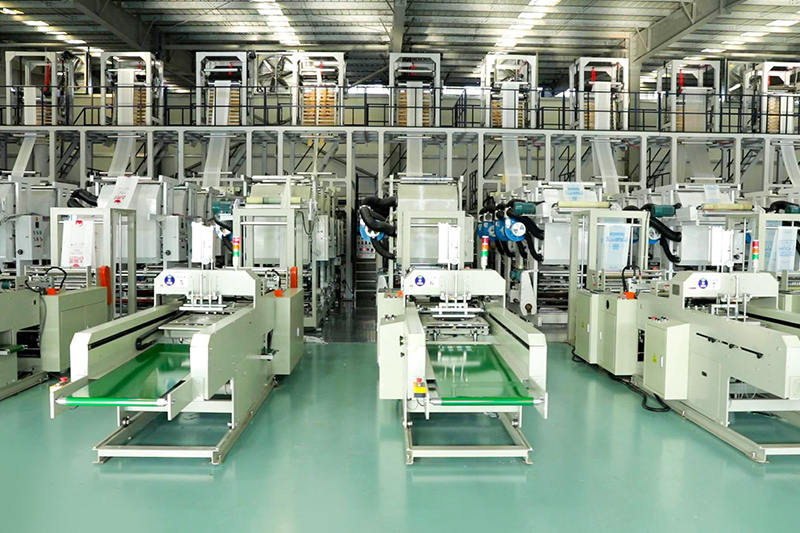
Working with Huayue Group
As a Diaper Plastic Packaging Bags Factory, Huayue Group produces Diaper Plastic Packaging Bags using BOPP/PET/CPP laminated materials, available in fully opaque or translucent finishes to meet moisture-proof requirements while giving brands the option of product visibility on shelf. Customization covers film thickness, bag width, bag length, base color, and full custom printing, with each parameter adjustable independently rather than fixed to standard template sizes.
For brands seeking Custom Baby Diaper Plastic Packaging Bags, minimum order quantity is 500 kg per order, making it accessible for both new brands testing a design and established brands running high-volume repeat production. Sample requests carry no sample fee.
Final Takeaway
Effective diaper packaging secures your product and elevates your brand on the shelf. As a dedicated manufacturer for diaper plastic packaging bags and baby care brands, Huayue Group is ready to bring your next packaging strategy to life. To request an accurate quote for custom bags, simply reach out with your project details—including diaper count and pack dimensions, desired laminate/barrier performance, film thickness, artwork colors, preferred bag format, order volume, and destination market requirements.
Packing Solutions
Related Products

Tel: +86 18019228135
E-mail: alfredren@huayuepack.com
Address: No.228 ZhaiXing Rd, XinSheng Industrial zone, ZheLin Town, FengXian District, ShangHai, China.

Copyright © 2026 Huayue Group Plastic Packaging Manufacturers
