
 English
 Español
Which Sizes Should Start a Private-Label Food Storage Bag Line?
Start with sandwich, quart and gallon.
That's the answer for a US supermarket aisle with three slots for private label food storage bags with press-to-close closures, sold by the box. If your shelf has more or fewer slots, or your program is built around portions or freezer use, the table below shows what would change the call.
Give each slot one job
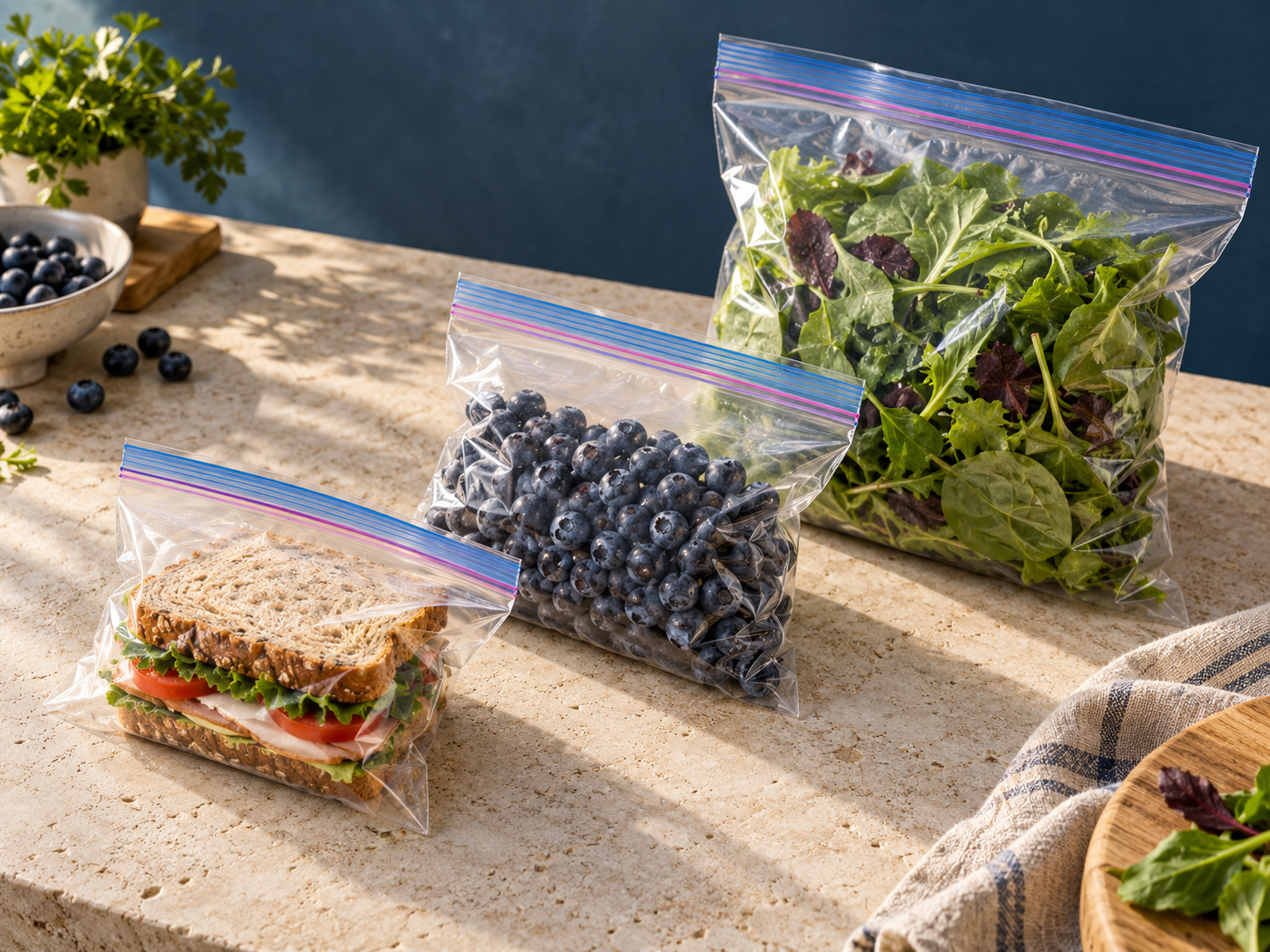
Nobody shops for a "quart bag". They shop for something to put berries in. So give each slot one job. If two sizes would hold the same food, one of them is redundant.
- Sandwich: flat, single-meal food. A sandwich, a wrap, crackers, cut fruit.
- Quart: the everyday middle. Berries, a cup or two of shredded cheese, leftover portions.
- Gallon: bulky or awkward food. A head of lettuce, a big bunch of greens, a pound or two of chicken going into a marinade, or several smaller items grouped together.
Here is how that plays out for all five candidates, including the two that wait:
|
Size |
Launch call |
When the call changes |
|
Sandwich |
Include |
Drop it only if lunch isn't part of your program. |
|
Quart |
Include |
Cut it only if a filled sandwich bag already holds your typical medium items (a cup of berries, a cup of shredded cheese) without bulging. |
|
Gallon |
Include |
Include it if you can name two or three foods that won't fit a filled quart. If you can't, launch with sandwich and quart and add the gallon later. |
|
Snack |
Wait |
It does the same job as sandwich unless you define your small slot as portions. If you do, swap snack in for sandwich. To carry both you need a fourth slot, plus a clear answer to what snack holds that sandwich doesn't. |
|
2-gallon |
Wait |
It's a real size and several brands sell it. Add it when you can name a specific food that won't fit a filled gallon. Without that, you're giving shelf space to a narrow need. |
One more point on snack: going by the typical dimensions below, snack and sandwich bags share the same width. In many setups that means the same film width and the same closure, with only the bag length changing. Confirm that with your supplier, but it's a good reason to treat snack as a cheap add later rather than a launch decision.
The numbers behind the sizes
A size name is shelf shorthand. Brands differ by a few millimetres, and the closure zone and side seals eat into the usable space, so a bag labelled gallon is smaller inside than its outer dimensions suggest. These are common US retail ranges, useful for comparing brand against brand:
|
Size |
Typical outer size |
Typical retail box count |
Typical film thickness |
|
Snack |
about 6.5 × 3.3 in (165 × 85 mm) |
roughly 90 to 120 |
storage: about 1 to 2 mil (25 to 50 µm) |
|
Sandwich |
about 6.5 × 6 in (165 × 150 mm) |
roughly 90 to 150 |
same |
|
Quart |
about 7 × 8 in (180 × 205 mm) |
roughly 40 to 50 |
storage: about 1 to 2 mil; freezer: about 2.5 mil (60 µm) and up |
|
Gallon |
about 10.5 × 11 in (270 × 280 mm) |
roughly 20 to 30 |
same as quart |
|
2-gallon |
about 13 × 15 in (330 × 380 mm) |
roughly 10 to 15 |
same as quart |
What each extra size costs you
This is where the factory's view differs most from the planning sheet. Changing from one bag size to another is not a setting on the same job. It is a changeover:
- The bag length changes, so the machine's feed and cut are reset.
- The film width and the zipper or slider position change with the bag width.
- The artwork is laid out for that bag, so each size needs its own printing plates or cylinders for each design.
- The retail carton and the shipping carton change dimensions, and the pack count changes with them.
Every one of those steps takes machine time and produces start-up waste, and that cost is spread over however many bags the run makes. Suppliers also set minimums per size and per design, not per program. A made-up example, so you can see the effect: if a supplier's minimum is 100,000 bags per size and design, five sizes commit you to 500,000 bags at launch and three sizes to 300,000. And if your launch budget is fixed, five sizes means each run is smaller and closer to that minimum, which is where unit price is highest.
So ask every supplier of private label food storage bags for the minimum in bags and in retail boxes, per size and per design, and for the price break if you double or quadruple the quantity of a size.
Two smaller effects stack on top:
- Bigger bags use more film and ship less efficiently. A carton holds 20 to 30 gallon bags against 90 or more sandwich bags, so freight per bag climbs with size.
- Shoppers compare price per bag, not per box. Check your planned gallon price per bag against the national brand's, because gallon is where a thin margin shows up first.
Freezer and slider are separate decisions
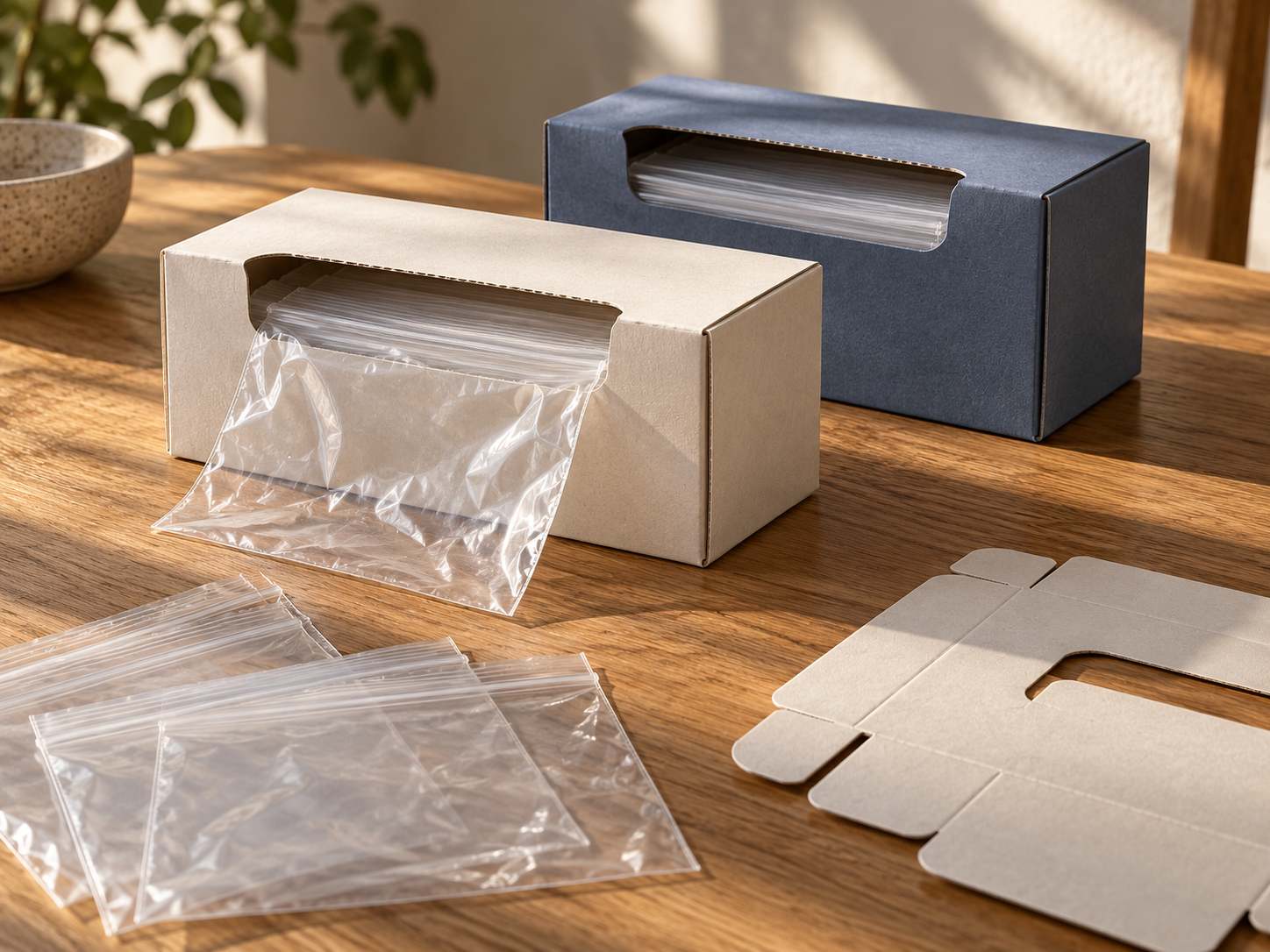
A freezer bag is a thicker film, not a bigger bag. If your program includes freezer positioning, spec it as its own line with its own film thickness. Don't copy the thickness over from the storage version of the same size.
The same goes for a slider closure. If you add one later, it tends to earn its keep on the larger, wider bags, where pinching the zipper shut across the full width is harder. Treat it as a closure decision, not as another size.
Test samples with real food
When samples arrive, don't measure them and call it done. Fill them.
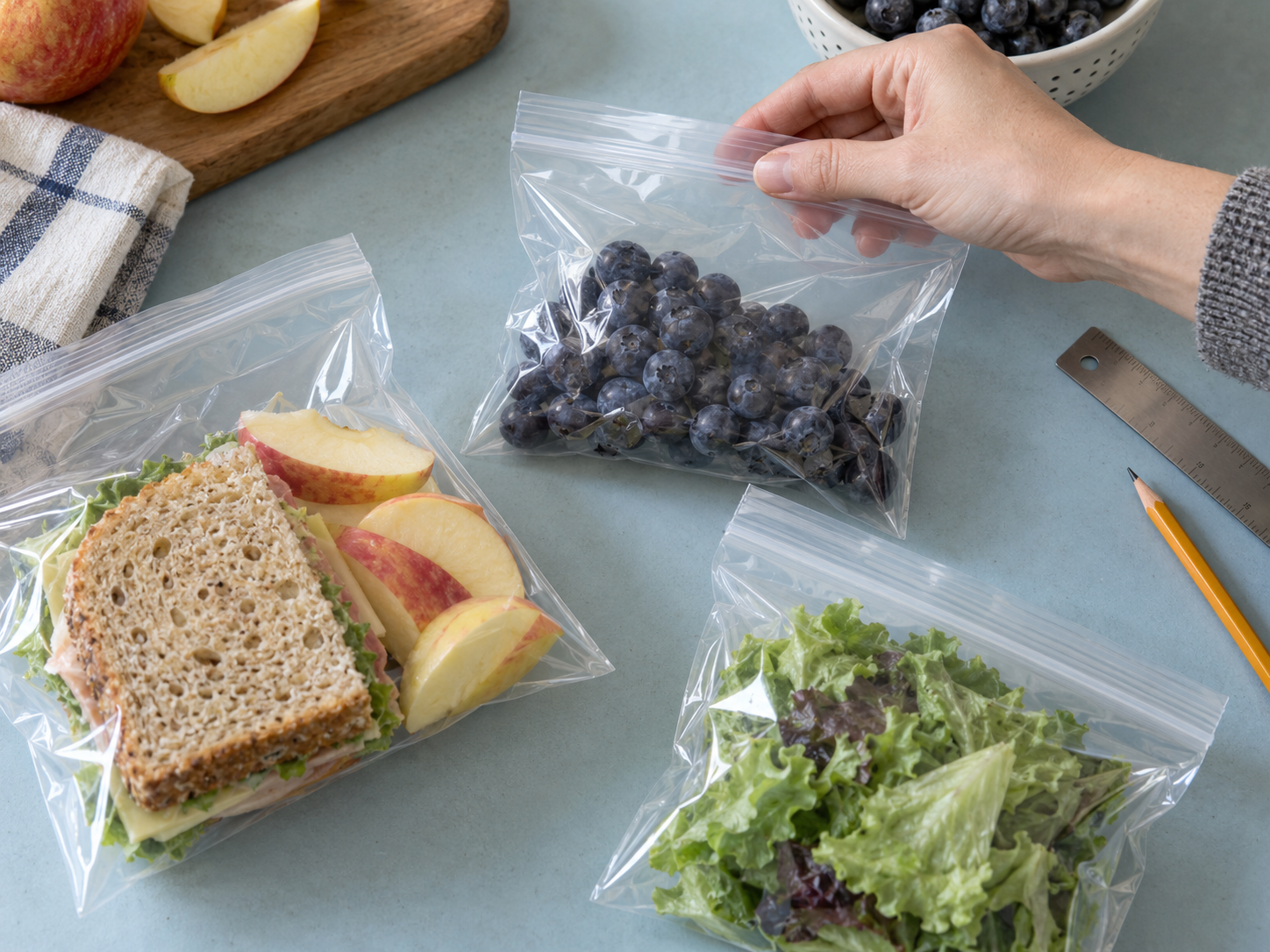
- Sandwich: half a sandwich plus a few apple slices. Close it and check whether the closure zone leaves room for the food.
- Quart: a cup of berries or a cup of shredded cheese. A bag that closes fine empty can bulge and pop open when it's full.
- Gallon: a head of lettuce or two pounds of chicken pieces. Seal it, hold it upside down and squeeze lightly.
Then leave the filled bags in the fridge overnight and open and close each one several times. Wet or oily food on the closure track is the usual way a zipper starts to fail, and you'd rather find that out on your desk than from customers.
Ask the supplier for the usable width and depth below the closure, and compare it against what your real contents need.
A simple way to phase it
Wave one: sandwich, quart and gallon, run through a couple of reorder cycles. Split the first order from your own category sales mix for those three sizes, not into equal thirds.
Wave two: add only what customers or the shelf ask for.
- Shoppers asking for a smaller portion bag points to snack.
- A named food that won't fit a filled gallon points to 2-gallon.
- A request for a thicker bag or an easier close is a film or closure conversation, not a new size.
Walk the national-brand aisle before you lock the list and note which sizes and freezer versions they carry. Whether your private label follows or skips some of them is a choice only you can make, but it should be a deliberate one.
Before you sign off a specification
- Film thickness: make sure it matches the position, storage or freezer, and wasn't carried over from another size.
- Carton and pallet: confirm the box count, how the carton fits your shelf, and how many cartons make a pallet, because that decides freight cost per bag.
- Minimums: get the per-size, per-design minimum in writing before you commit to a fourth or fifth size.
- Food-contact documentation: request it for the finished bag and your destination market. It is issued for the exact product, not for a size.
A size decision can't tell you demand, price, margin or shelf facings. Those come from your own category data.
Where Huayuepack fits
Huayuepack's food packaging range lists zip-seal, slider, gallon and quart, sandwich and snack products, and the zip-seal bag page names the snack, sandwich, quart and gallon classes. When you are ready to translate these shelf decisions into production specifications, Huayuepack can discuss specifications for custom zip seal bags and slider food bags for B2B and private-label programs.
For a quote or a sample plan for private label food storage bags, send your sales channel and destination market, the size classes you're considering, what goes in the bags, and your SKU limit through the contact page or alfredren@huayuepack.com.
Packing Solutions
Related Products

Tel: +86 18019228135
E-mail: alfredren@huayuepack.com
Address: No.228 ZhaiXing Rd, XinSheng Industrial zone, ZheLin Town, FengXian District, ShangHai, China.

Copyright © 2026 Huayue Group Plastic Packaging Manufacturers
